


[Policy paper]
AI and climate considerations
[ Date Published ]
9 June 2026
[ Focus area ]
Sustainability
[ Title ]
AI and climate considerations
Assessing trade-offs between national green agenda and data centre growth
[ Foreword ]
The relationship between technological progress and climate responsibility is often presented as a contradiction. Yet for countries like Malaysia, both objectives are equally important and must therefore be pursued at the same time. On one hand, Malaysia is seeking to position itself as an AI Nation by 2030, supported by growing investments in digital infrastructure and data centres. On the other hand, the country has committed to achieving net zero emissions by 2050. Undoubtedly, managing these parallel ambitions will be difficult, but smooth seas have never made a good sailor.
This paper approaches the issue with that reality in mind. It does not assume that economic development and environmental stewardship are mutually exclusive, nor does it treat technological advancement as inherently beneficial without scrutiny. Instead, it examines the trade-offs that accompany the rapid expansion of data centres, particularly in relation to energy demand, water usage and longer-term sustainability considerations.
Going forward, digital infrastructure will play an increasingly important role in economic growth, innovation and competitiveness. Countries across the region are actively positioning themselves to capture these investments, and Malaysia is no exception. The potential gains are significant, ranging from vast sums of foreign direct investment and ecosystem development to the strengthening of the country’s digital ambitions.
At the same time, large-scale infrastructure projects inevitably carry costs and risks that must be carefully understood. As climate pressures intensify and energy systems come under greater strain, questions surrounding sustainability can no longer be treated as secondary concerns. Policymaking in this area therefore cannot merely be driven by optimism or alarmism. It must instead be guided by evidence, transparency and a clear understanding of national priorities.
This paper was written in that spirit. Rather than arguing for or against any new infrastructure projects in absolutist terms, it contributes to a more informed and nuanced discussion on how Malaysia can balance economic opportunity with its broader environmental responsibilities.
Datuk Prof Dr Mohd Faiz Abdullah
Executive Chairman
[ Executive Summary ]
- Malaysia is experiencing a data centre boom, mostly in artificial intelligence data centres, which the government understands to be a high value-add on. This growth has been positioned as part of the national AI Roadmap towards becoming a regional high-technology powerhouse.
- However, Malaysia’s increasing adoption and construction of AI infrastructure undermines its ability to effectively pursue climate and environmental goals. The rapid build-up of energy- and water-intensive, foreign-owned AI data centres also contradicts the Roadmap’s prioritisation of domestic digital transformation across several key pillars.
- Alongside concerns around AI sovereignty, climate and meeting other national needs, Malaysia’s governance architecture lacks capacity to manage data centre growth and operations.
- An examination of data centre approvals reveals how these occasionally differ from the processes outlined in policy documents. Broadly, the instruments meant to govern the boom were designed for a smaller scale of infrastructure, prior generation of technology and more modest level of developmental ambitions.
- In addition, there is a gap between policy intent and operational reality. This is most visible in the moratorium on non-AI data centres which cannot be practically enforced, since a data centre’s activity remains unknown to operators and governments alike.
- Further, the projected AI ecosystem envisioned by the authorities may not actually materialise, meaning that Malaysia inadvertently subsidises the computational needs of foreign corporations, without securing commensurate returns in local innovation capacity.
- Recommendations include standardising a renewable energy certificate accounting framework, developing governance mechanisms for workload disclosure and verification, stipulating nationally beneficial uses and verifying operator claims, as well as adopting a whole-of-government approach through the appointment of a standing technical working group.
[ 1. Introduction: artificial intelligence in the age of climate change ]
Artificial intelligence (AI) is often encountered in its most visible and user-friendly form: the chatbot that helps draft emails or tutors a student through problem-solving. Generally defined, AI is “the capability of computer systems or algorithms to imitate intelligent human behavior”, or “a branch of computer science dealing with the simulation of intelligent human behavior by computers”.1 It is a broad and expanding family of technologies, each of which are designed for different purposes, rather than just a single general category.
While recent developments, such as large language models (LLMs), have received much attention, AI spans a spectrum ranging from systems designed to perform specific, well-defined tasks (narrow AI) to the theoretical and yet-unrealised frontier of artificial general intelligence.2 Every AI system deployed commercially today falls within the former category, including the most sophisticated generative AI tools (for example, ChatGPT and Gemini), which create “new” content by learning to identify and mimic patterns from across vast datasets.3 Further distinctions allow narrow AI to engage with energy systems and development goals through applied or discriminative AI tools, which classify, predict and detect data, and are capable of powering early-warning models for natural disasters.4
Such disasters, for instance floods or droughts, are only expected to intensify with the effects of anthropogenic climate change. Malaysia has pledged to address this crisis by ratifying the Paris Agreement, drafting the Climate Change Bill and establishing the National Energy Transition Roadmap (NETR), for instance. Ironically, it is precisely here that tensions arise between competing government policies. Malaysia’s increasing adoption and construction of AI infrastructure – manifested primarily in the growing data centre sector – undermines its ability to effectively pursue climate and environmental goals.
The root of this contradiction lies in the broad ecological cost of AI’s deployment, measured in terms of its energy and water demands. These are particularly salient at the data centres which constitute the underlying infrastructure of AI’s scalability. There are different types of centres for generative AI and applied AI functions, both of which consume energy at fundamentally different scales and require different infrastructural and computational capacities.
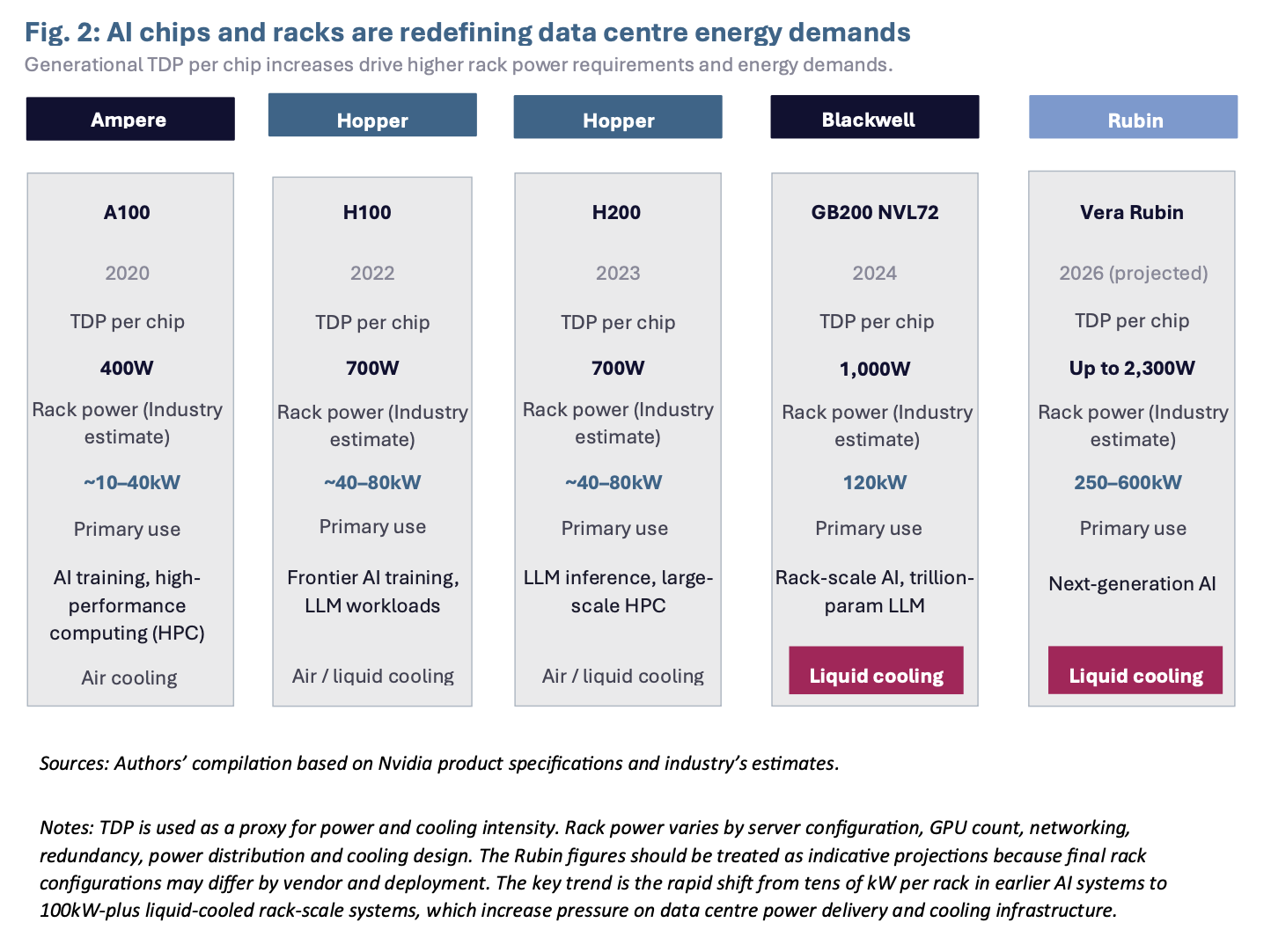
Traditional data centres, such as those used for data storage or web hosting, operate at power densities of 5–10kW per rack, whereas AI-optimised facilities with the same physical footprint require 60kW or more per rack.5, a This marks over a tenfold increase, driven by a shift in the type of integrated circuits, also known simply as “chips”, powering the boom. While central processing unit (CPU)-based traditional servers were previously used, graphics processing units (GPUs) have since become central to purpose-built accelerator clusters.6, b Their improved capacity, however, comes at a resource cost. A standard processing chip inside a traditional server uses around 75–200W of electricity, similar to a lightbulb in terms of energy consumption. But a single GPU chip, essential for AI applications, needs five to ten times as much energy, while generating a similar scale of additional heat.7 The resulting cooling demands present another technical challenge. AI data centres typically require liquid or immersion cooling systems, rather than the air-cooling infrastructure of their traditional counterparts. Electricity consumption in accelerated servers is projected to grow by 30% annually, mainly driven by AI adoption, whereas traditional server consumption grows at 9% per year.8
Malaysia’s AI-ready data centres are predominantly designed to support the GPU-intensive workloads of global technology companies engaged in LLM training and inferencing.c However, these use cases contrast distinctly with the applied AI priorities outlined in the Artificial Intelligence Roadmap (AI-RMap). In short, there is a disconnect between the type of AI use cases that Malaysia prioritises in its national strategy (such as flood forecasting, public health monitoring or traffic management), and the type of AI supported by the rapid build-out of infrastructure across the country. To this end, billions of ringgit in pledged hyperscale data centre investments have come in annually.9 These investments are framed within a narrative that positions Malaysia as Southeast Asia’s leading AI and data centre hub.10 But as argued below, the scale, composition and governance of this infrastructure raise questions that have not yet been adequately addressed.
Overall, three fundamental considerations in this policy brief are: (1) whether or not the scale of infrastructure currently being built actually corresponds with Malaysia’s present stated AI priorities; (2) whether the data centre boom might undermine Malaysia’s other policy goals, primarily those related to climate and the environment; and (3) the compromises and assumptions driving the boom. A more concrete analysis requires specific and exact information about data centres and their resource needs, but such data remain deliberately opaque. Government data sources are patchy, academic literature tends to lag behind rapid industry developments, while reports by industry players lack meaningful transparency. It was within these limitations that data collection for this brief was conducted.
This study draws upon published literature, spanning peer-reviewed research articles, government policy documents, industry reports and, where relevant, industry-commissioned sources (despite their subjective limitations). It also involved stakeholder engagement, comprising 15 interviews conducted in Malaysia, Singapore, Indonesia and the Philippines with stakeholders across five sectors (academia, industry, government, civil society and journalists) between March and April 2026. These anonymised oral sources captured operational knowledge and on-the-ground perspectives that complemented the published literature.
There are several limitations shaping what this study can, and cannot, claim. Operational data on energy consumption, water usage and carbon emissions are generally not publicly disclosed by most companies operating in Malaysia. Even where disclosed, measurements may not be standardised nor independently verifiable. Further, a number of interview findings cannot be corroborated by published sources. Therefore, they are used to frame analytical questions, rather than make definitive claims.
[ 2. Does the scale of AI infrastructure correspond with Malaysia's stated AI priorities? ]
2.1 Malaysia’s AI ambitions and its supporting infrastructure
Malaysia’s AI pursuit, assembled over the past five years, has been integral to its national development strategy. Launched in February 2021, the Malaysia Digital Economy Blueprint established a headline ambition of raising the digital economy’s share of gross domestic product (GDP) to 30% by 2030.11 The AI-RMap 2021–25, adopted by the Science, Technology and Innovation Ministry, identified five national priority sectors for AI deployment: agriculture, healthcare, smart cities, education and public services. In December 2024, the National AI Office (NAIO) was launched as the central coordinating body for AI governance and tasked with producing a national AI Code of Ethics and an AI Technology Action Plan for 2026–30. More recently, the 13th Malaysia Plan, tabled in July 2025, formalised the “AI Nation 2030” framework around five pillars: forward-looking policy, an agile workforce, secure digital infrastructure, digital trust and strategic public–private investment.12
The accompanying investment wave is striking in both scale and speed. Malaysian digital investments hit a record RM163.6 billion in 2024 alone (up 55.5% from the year prior), 76.8% in data centres and cloud infrastructure.13 In further deepening this national commitment, Budget 2026 allocated RM5.9 billion for research and development, RM2 billion for a Sovereign AI Cloud and RM2 billion for the MADANI Submarine Cable project, which aims to reduce digital congestion and improve support AI-driven data demands between Peninsular Malaysia and Sabah and Sarawak.
Indeed, emerging technologies, including AI, have reportedly allowed Malaysia’s digital economy to achieve a 19% year-over-year expansion in 2025, in part due to the growth of data centres.14 Their physical construction has proceeded at a pace that matches, and in some respects outpaces, the absorption capacity of supporting infrastructure. Between 2021 and June 2025, 143 data centre investment projects were approved, with total investment valued at RM 144.4 billion.15 In 2024 alone, nine projects were completed, with a total maximum demand of 1.3GW. As of that December, 38 projects had secured electricity supply agreements (ESA) with Tenaga Nasional Berhad (TNB), Malaysia’s primary electricity utility, with a combined maximum demand of 5.9GW.16 Johor has become the clear epicentre of this expansion, accounting for close to 80% of the country’s live information technology (IT) capacity, driven by affordable land prices, competitive electricity tariffs and strategic proximity to Singapore, whose 2019 data centre moratorium effectively redirected demand for hyperscale facilities northwards.17
Malaysia’s competitive advantages in attracting investment are warranted. Its key pull factors include affordable land and energy, a stable regulatory environment and strategic geography, while the Johor-Singapore Special Economic Zone has offered preferential tax treatment for qualifying investments since January 2025. However, the resulting structural questions are also important to consider. Data centre energy consumption is projected to surge to over 5,000MW by 2035, equivalent to 40% of Peninsular Malaysia’s present power capacity, thus requiring significant new generation capacity to accommodate growth. This projected increase sits uneasily alongside the country’s net-zero carbon emission commitments, with implications for the energy transition from fossil fuels to renewables. In considering the demands of expected growth trajectory, it is vital to ask how this growing demand for energy will be met.
2.2 Potential AI applications for climate and environmental action
This data centre boom may not satisfy Malaysia’s actual AI priorities. To recapitulate, the government’s ambition to become an AI nation by 2030 is increasingly being reflected in how digital and AI policy is positioned in economic strategies. The AI-RMap identifies agriculture, healthcare, smart cities, education and public services as the domains where AI should deliver national value. However, data centres are designed for GPU-intensive generative AI workloads serving predominantly external commercial demands. Both run on parallel tracks, yet are often conflated. The result is one of the more consequential analytical errors in current policy conversations. Whether one undermines the other is a key question addressed here.
The data centres that support leading industry players are built for GPU-intensive, high-density generative AI workloads. Heavier workloads are observed in commercially significant activities such as LLM training, AI inferencing and commercial inferencing at scale. But these represent only one category of AI, and do not necessarily fulfil the AI-RMap’s policy domains. National needs are instead best served by applied, task-specific and low-computation systems, which are already operational in Malaysian river basins, flood management systems, urban traffic networks and public hospitals.
Of specific interest is how the AI-RMap positions AI as a potential tool for addressing climate and environmental challenges. Applied AI has already demonstrated measurable value across several directly relevant domains. On flood prediction, for example, long short-term memory models (a deep learning tool) have been applied to the Klang River and produced a model that explains over 98% of variations in water level measurements. This level of predictive accuracy translates directly into earlier and more reliable flood warnings for downstream communities.18 With regard to renewable energy, the application of deep learning corrections to weather forecasting models have reduced solar irradiance estimation error by 44% at select sites. In doing so, it improves the financial case for integrating solar into the national grid by making output more predictable and grid-planning more reliable.19 These are the salient results of processing Malaysian data, not merely proof-of-concept demonstrations.20
When introduced systematically, AI tools may potentially help achieve Malaysia’s broader sustainability goals. However, at a global scale, early optimism about AI’s potential role in enabling sustainability has given way to a more differentiated picture. A systematic assessment by Vinuesa et al. found that AI can act as an enabler across 79% of the UN Sustainable Development Goals targets, with the highest potential for water management, disaster risk reduction, sustainable cities and clean energy.21 The same study, however, found that without deliberate governance, AI may conversely inhibit 35% of those same targets. Such enabling and inhibiting effects follow from the reasons for which AI infrastructure is built, whom it serves and under what conditions it operates. Further, applied AI applications, such as flood- or weather-forecasting models, consume negligible energy in comparison to the more energy-intensive generative AI operations housed by AI data centres,22 thus suggesting that installed computing capacity exceeds the AI-RMap’s actual needs.
2.3 Three climate and environmental tensions in AI
There is a duality with AI at every level of deployment. This results in inherent contradictions, most clearly seen in the idea of a “sustainable” data centre: an infrastructure which, under present conditions, may not feasibly exist.23 After all, its operations are energy-intensive, water-intensive and carbon-emitting, where efficiency optimisation alone cannot resolve three key structural tensions.
The first tension relates to energy, where the numbers are most arresting and directly relevant to Malaysia’s national commitments. The energy demands of AI and data centre growth require additional generational capacity. Therefore, the critical question is how this new capacity will be fuelled. The majority of Malaysia’s electricity supply is still generated from fossil fuels: a reliance that sits uncomfortably alongside the NETR’s ambitious target of 70% renewable installed capacity by 2050.24 In fact, Malaysia’s grid is projected to remain more than 75% fossil fuel-dependent until at least 2033, according to BMI (Fitch Solutions).25 This means that every additional megawatt consumed by a local AI data centre in the near future will be, in all likelihood, powered by natural gas or coal: the longstanding foundations of the energy mix. A second tension arises in competition for water resources, which, as it stands, is least reflected in current policy. As explained below, Malaysia’s current water governance architecture is not yet equipped to manage both domestic and emerging industrial demands.26
A third tension emerges from carbon accounting practices, where a significant policy framework gap threatens to undermine Malaysia’s own sustainability claims. Data centres routinely purchase Renewable Energy Certificates (RECs), presenting themselves as “green” or “carbon-neutral” operators.27, d However, the reality is that a data centre can still consume electricity from coal-fired power sources on the Malaysian grid, but purchase cheaper RECs sourced from elsewhere. Thus, a data centre might be “carbon-neutral” in the technical sense, but its emissions are still produced within Malaysia’s borders. The double-counting of RECs – when two different parties claim the same environmental benefits from the same generated green power – also remains possible. For example, two data centres may claim to be 100% solar powered. The first owns an on-site solar array that generates electricity, but sells energy attributes (that is, as RECs) to finance their solar array; meanwhile, the second purchases RECs that were made possible by the first’s solar energy system.28 While both data centres may claim to be 100% green powered, only the latter has a legitimate claim since it has a binding contract. In addition, not unlike other carbon-emitting industries, the additionality of RECs remains a challenge: that is, whether the carbon would have otherwise been offset without the RECs.29 Meanwhile, Malaysia’s Corporate Renewable Energy Supply Scheme, launched in 2024, does enable direct procurement of renewable energy from independent producers.
In short, as demand for AI grows – and by extension, the continued expansion of data centres – these infrastructures must reflect coherent national policy and be climatically, environmentally and socially sustainable to safeguard Malaysians from the impacts of climate change as well as other resulting economic costs.
[ 3. How does the AI and data centre sector boom relate to Malaysia’s other policy goals? ]
There are emerging concerns about whether the assumptions driving AI and data centre growth hold up to critical scrutiny, and if the current governance architecture meant to manage the resulting consequences are fit for purpose. These interlinked concerns can be broken down into three questions.
3.1 Does Malaysia need local hosting at the current and projected scale?
Hyperscalers and the Malaysian government alike have broadly touted the local hosting of data centres as prerequisites of AI-readiness. For example, a March 2025 Microsoft article, “Why Malaysia needs datacentres for an AI-powered future”,30 is premised upon the underlying assumption that such centres are intricately tied to Malaysia’s AI use cases, be they at the national, private sector or individual levels.
Another key argument for hosting data centres is reduced latency.31,e Speed and connectivity should technically improve for businesses and retail customers alike, since data travels a shorter physical distance between users and where it is being hosted.32 Local businesses would benefit by effectively implementing advanced technologies for real-time decision-making, while online retailers see gains from enhanced customer experience. On this basis, companies like Huawei have promoted their data centres in Malaysia as being capable of reducing latency regionally. Specifically, it claims that a direct connection to the public cloud Cloud Alpha Edge data centre (jointly developed by Huawei and Telekom Malaysia) can reduce latency by 85%, besides being cheaper than an international connection to Asia.33 Arguably, local actors, such as AI start-ups, have gained advantages from having a local data centre presence and reduced latency. An LLM start-up shared that once the AWS Asia Pacific data centre in Kuala Lumpur went live, the company was able to shift workloads from the United States of America to a data centre closer to home.
Further, by assuming that sovereign AI is beneficial, Malaysia stands to benefit from having more data, infrastructure and talent – the three pillars of sovereign AI – hosted locally.34 Malaysia’s data centre boom contributes to the second pillar, by strengthening critical AI infrastructure for both economic and national security. Reducing a reliance on foreign AI technologies by developing domestic AI capabilities would theoretically reduce licencing fees, AI subscriptions and reliance on foreign cloud architecture and offering protection against potential supply chain disruptions.35 Using domestic servers and localising LLMs also means that data is processed locally, thus safeguarding user privacy. Malaysia potentially has much to gain if it achieves AI sovereignty, but data centres alone are just a part of the equation: the reduction of an external reliance on advanced chips, meanwhile, is an impossible reality.36 The argument for AI sovereignty is further put into question after considering that all hyperscalers are foreign-owned, as discussed below.
Also, it is neither clear what workloads will run on the AI data centres, nor whom they serve. A data centre operator shared that companies are not obliged to reveal what they host or run in these centres. In fact, neither operators nor the government are privy to what is being processed in these facilities. The government’s February 2026 announcement that it aims to attract only data centres related to AI, in order to reduce pressure on the national grid and water supply, may be intended to benefit the local economy.37,f When Prime Minister Anwar Ibrahim affirmed this decision, he also highlighted how AI-related data centres offer relevant high-technology benefits.38 However, since there are currently no mechanisms governing what these so-called AI data centres can be used for, their true benefits cannot be accurately measured.
Another gap emerges in the lack of clarity over how much of the contracted data centre pipeline actually serves national computational needs. For the most part, extractive private corporations (particularly hyperscale operations) accrue the benefits from data centres more visibly than they support national interests. A data centre used for training LLMs may benefit from low latency connections to other available zones in the region, but how exactly does this centre contribute positively to Malaysia’s AI goals? Instead, “Big Tech” firms and multinational platform operators capture most of the value generated, whereas domestic start-ups, despite improved access to local computational capacity, remain constrained by foreign software dependencies, licensing costs and data storage obligations.39
3.2 Do the climate and environmental costs add up?
Data centre electricity consumption and pipeline loads have continued increasing over the past year. According to TNB’s Q4 analyst briefing for the 2025 financial year, as of the year-end, a total of 35 projects were in operation, with 7.5GW in cumulative maximum demand secured.40 The year-on-year load utilisation more than doubled, from 405MW in December 2024 to 850MW in December 2025. According to TNB’s annual report, a “significant portion of new demand in the pipeline [is] scheduled for energisation over the next one to three years.”41 The cumulative maximum demand, based on these reported latest figures, represents 16% of total generation capacity. This amounts to 54% of Peninsular Malaysia’s total contracted capacity (13.8GW), which notably increased from 43% the previous year.42 Yet this figure, already “hazardously high”, has not prevented growing demand for energy.
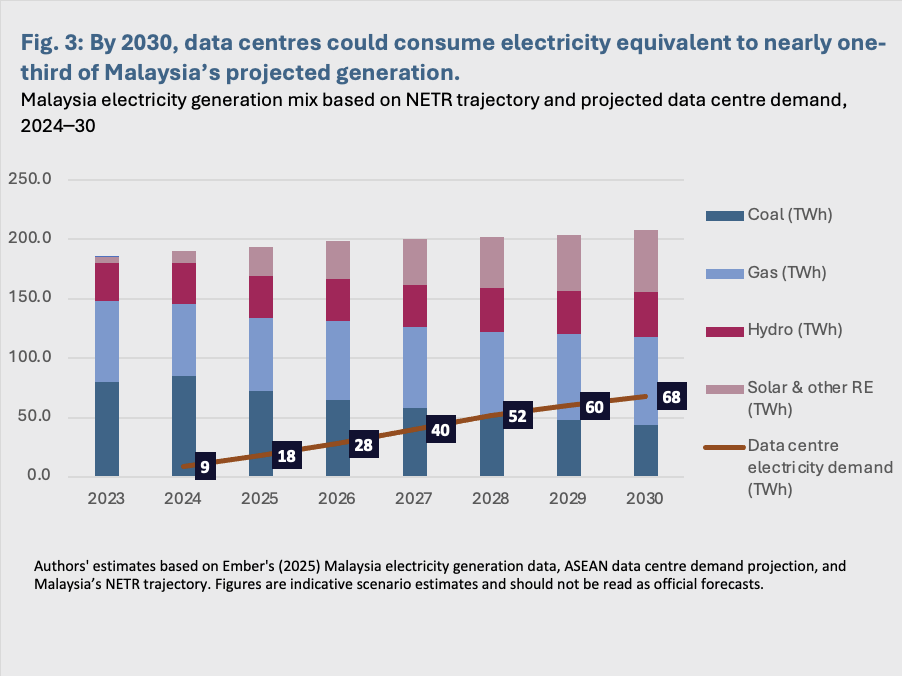
This increasing demand compromises Malaysia’s energy transition, given that renewables only constitute a fraction of the energy mix. The country’s installed renewable energy capacity was 31% as of December 2025, with fossil fuel-based, carbon-intensive generation (primarily coal and natural gas) still dominant.43 Ember Energy projects that Malaysia’s data centre electricity demand will surge from 9–68TWh in 2024–30, accounting for approximately 30% of national energy consumption, with emissions potentially rising sevenfold under the current fossil fuel-heavy grid trajectory.44 For scale, this projected demand surpasses the entirety of Singapore’s entire 2023 electricity demand (57TWh).45
To meet expected demand, Malaysia will need to add 6–8GW of new generation capacity by 2030.46 This is an approximately 40–54% increase from the current 15GW of gas-fired capacity, which is necessary to address the surge in demand from the data centre sector, according to TNB’s chief executive officer, Megat Jalaluddin.47Unfortunately, expectations of more “efficient” data centres as energy transition targets are progressively met over time are unlikely. Despite the NETR’s 70% renewable installed capacity target by 2050, Ember Energy estimates that its generation share will only reach approximately 52% due to the structural gap between installed capacity and actual generation.48
Water demands are also critical. It is estimated that training a LLM (such as GPT-3) in a United States data centre consumes approximately 5.4 million litres of water (equivalent to the daily water usage of approximately 10,000 people), and that inference alone consumes roughly 0.5 litres per every 10–50 medium-length responses.49 Globally, AI-driven water withdrawal is projected to reach 4.2–6.6 billion cubic metres by 2027, comparable to half the United Kingdom’s total annual freshwater use.50 In Johor, where Malaysia’s data centre density is highest, considerations over the water supply are already straining infrastructure. The gap between supply and demand is so great that the state’s new data centre projects have to wait until mid-2027 for water connections.51 The National Water Services Commission (Suruhanjaya Perkhidmatan Air Negara, or SPAN) has indicated that of the approximately 808 million litres per day of water requested by data centre projects across Johor, Selangor and Negeri Sembilan, only under 20% (around 142 million litres) can be realistically supplied, leaving most contracted demand unmet.52 Government estimates show that cooling these facilities requires roughly 675 million litres of water per day (equivalent to the daily water consumption of approximately 700,000 to 800,000 households), sharpening scrutiny over how Malaysia can balance its digital ambitions against the maintenance of resource security.53
3.3 Is governance architecture being developed in tandem with AI growth?
The architecture meant to manage climate and environmental risks is fragmented, voluntary and, as stakeholder interviews corroborate, insufficiently matched to the scale and pace of data centre development. An examination of data centre approvals reveals how these occasionally differ from the processes outlined in policy documents. Broadly, the instruments meant to govern Malaysia’s data centre boom were designed for a smaller scale of infrastructure, prior generation of technology and more modest developmental ambitions.
Fragmentation begins with the approval process, which involves multiple processes across different institutions, each operating with their own set of criteria. It is fundamentally intertwined with the complexity of federal–state relations and their differing lists. At the federal level, the Data Centre Task Force (DCTF, established February 2025) governs investment endorsements, incentive eligibility, sustainability compliance and power demand coordination, where the Malaysian Investment Development Authority (MIDA) is designated as the lead approval agency. Meanwhile, at the state and local levels, state planning committees and local authorities govern whether a data centre may be built on a given site. In Johor’s case, there is also the Johor State Data Centre Development Coordination Committee (Jawatankuasa Penyelarasan Pembanguan Pusat Data Negeri Johor, or JPPDNJ) to work with. Final approval must be in line with the National Land Code 1965 and the Town and Country Planning Act 1976, where planning and land powers are vested in state authorities rather than their federal counterparts. Meanwhile, utility approvals run as separate processes. This leads to situations where, for example, a project may secure federal investment endorsement while awaiting state planning approval, or it may secure planning approval but utility connections are deferred.
There is no single, publicly available standard operating procedure that consolidates these processes or ensures that a sustainability requirement applied at one level is reflected at another. The DCTF has committed to “strategic coordination with state governments”, yet no enabling mechanism has been publicly defined. Meanwhile, the extent to which federal and state agencies discuss individual project applications at the working level remains unclear.
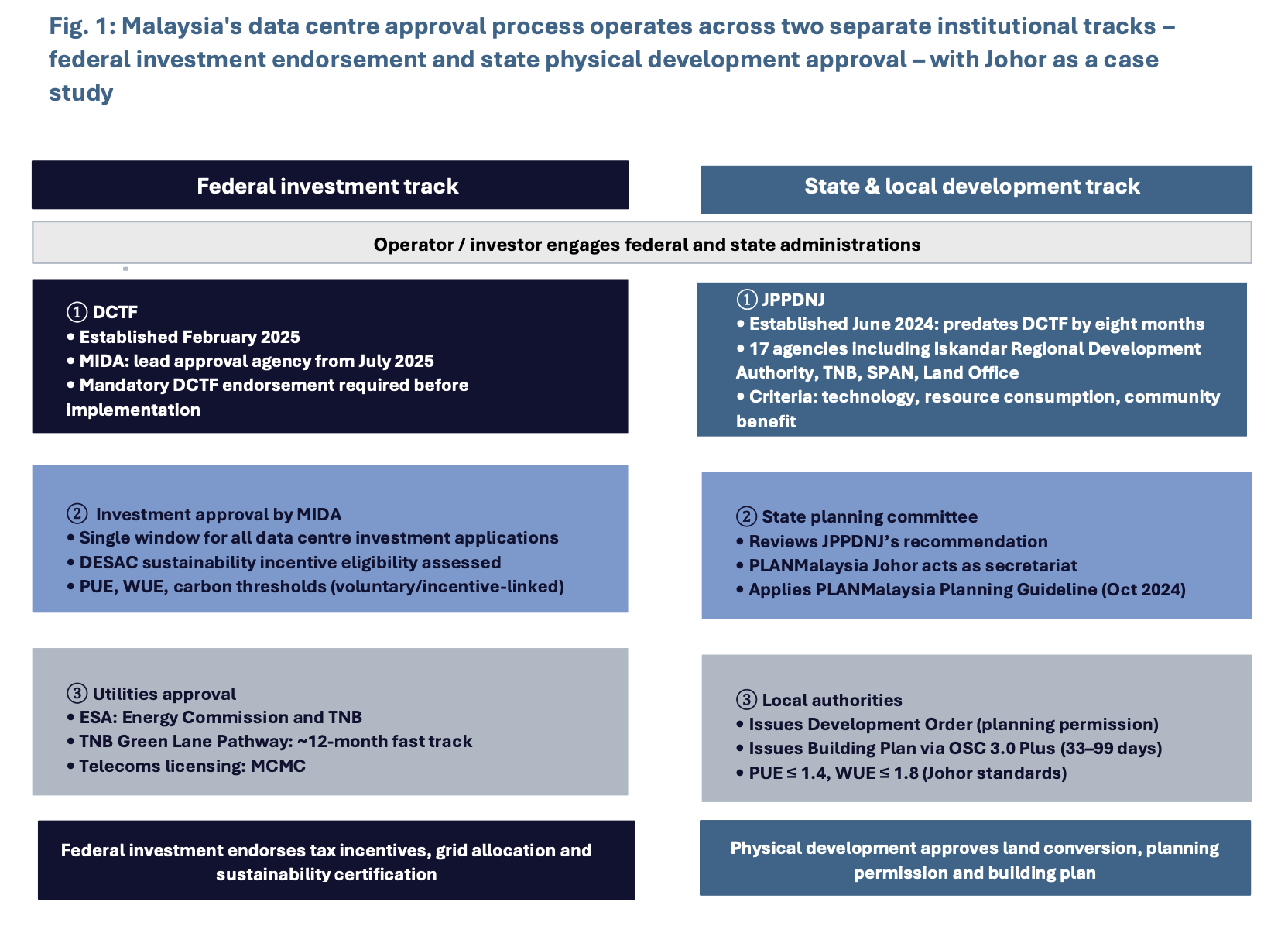
Johor provides a useful case study, as gauged from discussions with several government stakeholders. The JPPDNJ precedes the federal DCTF’s formation, and the criteria that it assesses differ materially. One stakeholder described a two-stage vetting process: (1) screening, technical evaluation, a full JPPDNJ committee meeting and the involvement of the State Planning Committee; before (2) securing final approval from local authorities, such as city councils. These assessments evaluate three criteria (which are absent from any publicly published guidelines): (1) the type of technology deployed; (2) volume of resources consumed; and (3) community perceptions and benefits. Electricity is not the committee’s primary concern, because substation infrastructure is managed separately and easily erected. Instead, well-founded considerations around water and the quality of technology dominate assessment. Separately, another stakeholder noted that plans to use river water for cooling exist, but face prohibitive treatment costs, while desalination proposals remain under discussion. A third stakeholder explained that water security in Johor is entangled with legacy issues around ageing pipe infrastructure and concerns about reservoir limits. These concerns are not technical problems susceptible to a data centre’s power usage effectiveness (PUE) threshold, but institutional challenges that remain unresolved under current governmental architecture.
Further, a tension emerges from the gap between policy intent and operational reality. Consider the February 2026 restrictions on non-AI data centres, which followed announcements since September 2024 claiming that a more selective approval process would be implemented.54 But as discussed above, operators cannot contractually guarantee or verify what tenants do with computing capacity once the facilities are built and leased out. A hyperscale campus marketed as being AI-ready may host AI training, AI inferencing, conventional cloud workloads or a combination of these activities, with the composition shifting in response to tenant demand. Consequently, this moratorium, as a policy instrument, rests on a categorical distinction that the physical infrastructure of a data centre cannot reliably enforce. In practice, the authorities can only assess physical hardware, for example design specifications (such as rack density, cooling architecture and power density) as proxy measures for AI readiness (which the JPPDNJ already informally assesses through its technology criterion). Since design specifications do not equal workload verification, a gap between policy intent and operational reality emerges.
Further, federal- and state-level “sustainable” data centre guidelines are insufficiently enforceable or else rely on outdated metrics. PLANMalaysia only has a “Planning Guideline for Data Centres” which provides guidance for sustainable development and operations, rather than necessitates compliance.55 In contrast, the Investment, Trade and Industry MInistry’s (MITI) “Guideline for Sustainable Development of Data Centres” may be more robust, since it sets PUE and water usage effectiveness (WUE) thresholds as preconditions for Digital Ecosystem Acceleration Scheme (DESAC) tax incentives.56 Both PUE and WUE are valued as governance instruments, but are increasingly rendered obsolete by the type and density of GPUs used in racks. In fact, industry stakeholders noted that AI infrastructure’s energy and water footprint is increasingly a function of chip architecture, rather than facility design. As GPU rack densities and chip energy demands increase, a specialised facility can still achieve a compliant PUE value, even while consuming, in absolute terms, an amount of energy several orders of magnitude higher than a traditional data centre.g Further, both sustainability guidelines mentioned above only apply relative measures and, having being calibrated to earlier chip generations, fail to account for the exponential growth in thermal design power (TDP) per chip. They were both issued during the same window when the Nvidia GB200 NVL72 chips were first shipped to major cloud providers (see Fig. 2). Each of Nvidia’s subsequent generations of chips widens the gap between what these (relative) metrics measure, and what drives the (absolute) energy and water footprint of AI infrastructure.
Finally, the growing gap between rapid data centre growth and a governing framework highlights a tension between two competing sectoral modalities: expansion and regulation. Malaysia’s AI governance framework remains exploratory rather than regulation-oriented. Indeed, the pipeline of centres coming online has not slowed. For a regional comparison, Singapore’s Green Data Centre Roadmap 2024 makes the achievement of three criteria (PUE ≤1.25, 50% green energy-sourcing and BCA-IMDA Green Mark Platinum certification) binding conditions of capacity approval, and not simply voluntary measures so that data centres can qualify for incentives. Australia’s Expectations of Data Centres and AI Infrastructure Developers, meanwhile, sets public conditions (national interest, clean energy additionality, water transparency, skills and start-up computation access) and explicitly ties data centre construction to its national AI strategy.57
[ 4. What are the underlying compromises and assumptions of the sector’s boom? ]
Malaysia has made extractive bargains before, and each time the central questions were the same. What is being given up? What is being returned? Is the exchange worth it? A comparison with other extractive industries makes the scale of Malaysia’s concessions more legible. Johor itself has been host to extractive industries such as palm oil plantations – which are in fact being cleared to make way for data centres – thus suggesting a fundamental continuity in extractive logics.58 Some industries generated lasting national capability, while others extracted more than they returned. Malaysia is living with the climatic and environmental consequences of the latter. The rapid development of data centres deserves the same degree of scrutiny, since it produces a more uncertain, and less comfortable, picture than headline investment figures and projections suggest.
Some key concessions that Malaysia is making, in the pursuit of data centres as an engine of growth, include: a coherent pursuit of its climate, energy and environmental goals; national sovereignty over the use of data centres; and a deepening reliance on exploratory modes of development without sufficient regulation, to name a few.
It is worth asking what Malaysia is getting back from the data centre boom. It is true that the data centre sector contributed significantly to total economic output in 2021–25, creating 1,429 jobs across the economy.59 However, compared with economic sectors such as manufacturing (employing 2.4 million workers, with cumulative wages of RM99.3 billion)60 and palm oil (contributing RM40 billion annually to the GDP, with a workforce of approximately 382,000), data centres currently fare worse than these industries in terms of offering employment opportunities. The sector is capital- and resource-intensive by design, but operationally low-maintenance. A 100MW hyperscale facility represents hundreds of millions in investment, but may only employ a few hundred operational staff, the majority of whom occupy low-paying janitorial and security jobs.61 There may, of course, be downstream effects (where every direct job in the industry supports an additional 3.2 jobs elsewhere in the economy), but it operates on a base that is small relative to the concessions being made.62
On a more abstract level, there is a reverse argument to consider. Does increased AI computing capacity displace other workers? Cheng et al. found that 4.2 million Malaysian workers (28% of the labour force) are highly exposed to generative AI technologies, while another 2.5 million fall in the medium-to-high exposure category.63 The relatively small number of positions that the data centre sector supports today (rising to a projected 30,900 by 2030) contrasts starkly against the precarity for 4.2 million Malaysian workers, who are already highly exposed to displacement. The global AI ecosystem driving data centre growth may increase the demand for engineers, cloud specialists and AI-related talent, while enabling systems that reshape work in exposed sectors.
Granted, causality cannot be established between local data centre expansion and worker displacement, given limited transparency over tenants, workloads and downstream AI applications. The argument here is that local AI data centres form part of the global infrastructure ecosystem enabling AI deployment, which may generate demand for AI-related talent while also supporting systems that increase worker precarity in other sectors. But precarity cannot be addressed at the national scale alone. If worldwide AI adoption trends continue, job displacement will happen, regardless of whether Malaysia hosts data centres or not. Similarly, an argument can be made that AI-related engineering jobs are being created due to the flourishing AI ecosystem (as a result of the boom). Regardless, the jobs that the sector creates are specialist and few; the jobs that it enables AI to automate are general and many. This is not a blanket argument against AI adoption, however, since AI can complement existing workflows, where workers with human-edge skills may see wage premiums.64 The labour market gains and vulnerabilities linked to AI infrastructure therefore need careful assessment.
Beyond jobs, the stakeholders interviewed were candid about what exactly state governments are banking on in their respective data centre pursuits. It is certainly not the revenue that otherwise dominates headlines. A government stakeholder involved in Johor’s approval process noted that the state does not capture significant fiscal revenue from data centre operations directly. Land sale proceeds accrue to landowners and corporate income tax flows federally (even then, DESAC incentives reduce the federal tax take at precisely the point when it would otherwise be largest).h In practice, state governments actually help absorb the planning, land-use, utility and environmental pressures associated with data centre growth, while the main fiscal instrument used to attract investments is designed and captured at the federal level.
What states are actually betting on is the eventual emergence of an AI ecosystem – such as downstream businesses, start-ups, talent spill-overs and knowledge accumulation – that a critical mass of infrastructure is assumed to attract. But this is a gamble. At present, no independent study has assessed whether the economic possibilities of data centres are actually being realised. An industry stakeholder framed the current phase as an “infrastructure bet”, where the facilities being built are the preconditions or prerequisites for speculative future economic activity. Whether or not this logic holds depends entirely on if an AI ecosystem actually materialises, and whether federal and state governments are then positioned to capture value. The Asia Society Policy Institute has named a risk directly: there is a genuine possibility that Malaysia ends up subsidising the computational needs of foreign corporations, without securing commensurate returns in local innovation capacity.65 A stakeholder raised the prospect of stranded assets, where facilities built at extraordinary cost may fail to generate the desired AI ecosystem economy, leaving Malaysia with climate and environmental liabilities, but without the industrial capability to manage these concerns.
Such a scenario fits into the pattern of extractive bargains that may not deliver. The window of opportunity to make agentic choices remains open, but it is narrowing. Ultimately, the economic benefits of Malaysia’s data centre boom remain speculative possibilities rather than certainties. The climate and environment costs are already present and further compromised by the data centre sectoral push. Meanwhile, the awareness and political will needed to establish a coherent policy framework is dangerously low.
[ 5. Opportunities amidst challenges ]
5.1 Tropical technology adaptation as a competitive advantage
Sectoral environmental costs are partly a function of design mismatch. Energy-intensive, air-based cooling systems dominated 72% of the Malaysian data centre cooling market in 2024, even as rack densities in AI-optimised facilities surged to physically untenable levels.66,i Malaysian facilities must rely on year-round mechanical cooling, climatically lacking the free-cooling hours which enable efficiency gains in temperate climes. However, neither the federal approval guidelines (PLANMalaysia and MITI) nor state-level mechanisms (JPPDNJ) specify what type of cooling approach is appropriate for tropical conditions.
This is not to say that Malaysia’s tropical climate is necessarily a disadvantage. Looking at best regional practices, evidence for what is technically achievable comes from Singapore’s Sustainable Tropical Data Centre Testbed (STDCT), which tests six technology streams calibrated for hot and humid conditions.67 Rather than providing ready-made solutions for adoption, it provides a basis for assessing what is feasible, its stage of readiness and what is preventing adoption in a particular national context. Testbed targets include ≥25% energy savings and 30–40% water use reduction. The four work packages (WP) summarised in Table 1 are the most promising, even if they are still unaudited programme-level goals, rather than confirmed operational outcomes.68
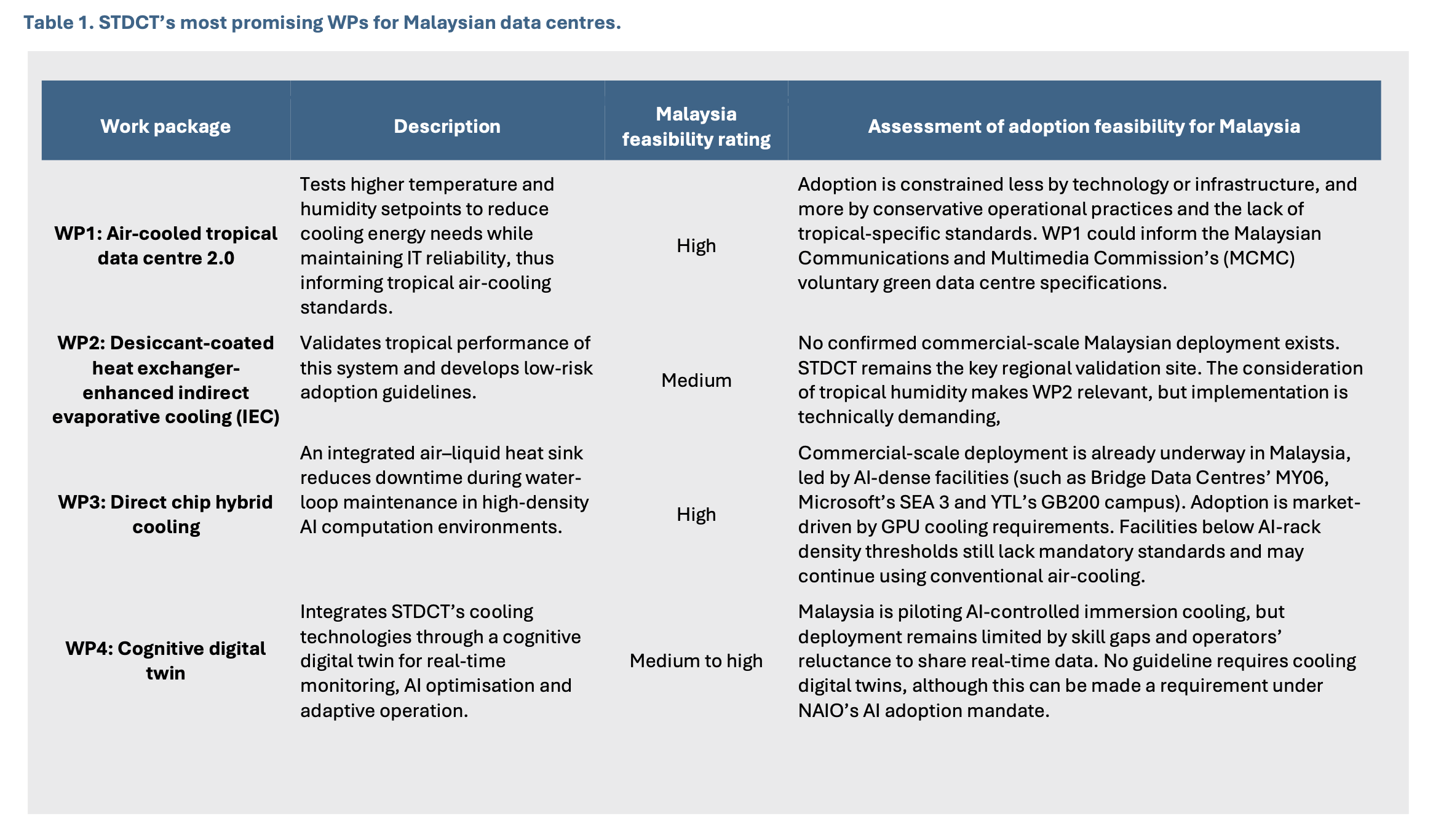
These WPs map cleanly and feasibly onto Malaysia’s specific needs. WP1 and WP3 offer the most promising prospects. WP3 (direct chip hybrid cooling) has already arrived in Malaysia, driven by commercial necessity to support GPU architecture at AI rack densities, but its adoption is market- rather than policy-driven. For facilities below this density threshold, no mandatory standard exists, and so operators default to conventional air-cooling. WP1 (air-cooled Tropical Data Centre 2.0) is also feasible because it requires no new hardware. Rather, it simply adjusts server inlet temperatures and humidity setpoints to tropical climate-appropriate levels, constituting an operational change rather than an infrastructural investment. These findings can directly enable MCMC’s voluntary green data centre specifications to be implemented at near-zero cost, but no mechanism exists to convert STDCT’s research outputs into Malaysian guidelines. Further, another barrier to adoption is the absence of a validated tropical standard.
WP2 and WP4, meanwhile, reveal how policy is actively failing to support adoption through structural barriers. WP2 (desiccant-coated heat exchanger-enhanced IEC) is validated specifically for tropical humid conditions, yet no Malaysian operator has commercially adopted it yet. There is neither an additional incentive to invest in this system, nor are there policy signals which promote innovation beyond minimum requirements. For instance, DESAC-linked PUE targets do not mandate how PUE should be achieved, and as such, a facility that meets its threshold using conventional chillers already qualifies. As for WP4 (the cognitive digital twin), it has been advanced commercially in Singapore. A data centre operating locally is currently piloting two-phase immersion with AI-driven controls, reporting up to 50% rack density improvement and 30–40% cooling energy reduction.69 Similarly, no guidelines mandate digital twin deployment, while operators’ reluctance to share real-time operational data creates a structural adoption barrier.
Taken together, technological adoption is already happening where commercially unavoidable. Otherwise, Malaysia is falling short in using standards and regulatory incentives to incentivise adoption. Several stakeholders independently argued that Malaysia should orient its data centre sector towards energy-efficient inferencing, rather than competing for power-intensive training workloads. Such a pivot will arguably attract operators reliant upon a grid powered by a clean energy mix that provides surplus and stable energy. This positioning is analytically sound, environmentally coherent and supports Malaysia’s climate commitments and energy transition goals, rather than impedes them. But capturing this market, which has not yet been encouraged by current voluntary guidelines and the absence of cooling technology criteria, requires that Malaysia firmly decides which technology standard to enforce.
5.2 AI as an enabler of climate and environmental action
Applied AI can be one of the most useful tools for managing Malaysia’s climate and environmental challenges. Flood prediction models trained on Malaysian river data already achieve accuracy levels that conventional hydrological methods cannot match. Internet of Things-based water quality monitoring systems have demonstrated sensor accuracy above 99% during riverine deployment. Renewable energy forecasting algorithms have reduced solar and wind estimation error by more than 40% at Malaysian sites.70 The Forbes Technology Council has identified these application domains as among the highest-impact applied AI deployments globally.71 The Commonwealth Scientific and Industrial Research Organisation’s AI for Climate Roadmap charts the same set of priorities across emergency management, water systems, agriculture and energy, explicitly distinguishing them from the generative AI infrastructure driving the data centre boom.72
Why, then, is Malaysia yet to witness these potentially dramatic improvements? Malaysia has plans to regulate data centre designs and criteria, but there are no governance frameworks mandating AI infrastructure allocations for beneficial use cases. The computational capacity of national data centre developments is substantial, and from a raw capacity standpoint, more than sufficient to host every climate AI application that the country needs. Yet there is no requirement that commercial data centres allocate capacity for government workloads, and there is no incentive for them to do so. Additionally, there is no procurement framework that would allow government agencies to use these centres, even if they wanted to. In this sense, commercially oriented infrastructure being built in Johor is, in many cases, not even relevant to state needs. Thus, the data centre boom and Malaysia’s climate AI agenda are presently entirely disconnected, and policies to connect them are currently absent.
What emerges is an implementation challenge. A case study of failures to improve climate and environmental outcomes in Johor illustrates this contradiction. Its flood warning application, Saifon (launched 2023), has only been downloaded 250 times as of October 2025, despite how Johor’s flood losses reached RM72.1 million in 2025, making it the third worst-affected state nationally, after Terengganu and Kelantan.73 A similar gap appears in pollution governance, where 14 of Johor’s rivers fall in the “most polluted” category of the National Water Quality Standards.74 Interviews with stakeholders confirmed that AI-enabled river monitoring, trash interception, flood sensors and tidal identification are being discussed at the state level, but have yet to see deployment even though the research is available and risks are immediate.
This failure to deploy climate AI applications is often incorrectly attributed to technological immaturity or insufficient computing power. The first explanation holds that the relevant technology is not ready, despite peer-reviewed literature showing that existing applications can work under Malaysian conditions.75 The second argues that the required computational power is unavailable, but some stakeholders independently stressed that computational needs for climate AI applications are modest. Flood forecasting models, water quality anomaly detectors and tidal classifiers are not frontier AI workloads, and certainly do not require GPU clusters or the 60–120kW per rack densities driving Malaysia’s current data centre pipeline. In most cases, a single mid-tier server would provide sufficient capacity.
Another constraint revolves around how data is being stored, and whether it can be accessed and integrated in usable form. Stakeholders from both government and technology sectors have identified that Johor’s climate and environment data largely exist in silos. These are stored on individual agency systems on separate premises (if they exist at all), or else outsourced piecemeal to third-party providers under arrangements that prevent data integration at scale. For example, river gauge readings are kept with the Department of Irrigation and Drainage, water quality data with the Department of Environment and SPAN, tidal data with the Marine Department and flood sensor telemetry with the state authorities. These authorities do not communicate with each other in real-time, and hence, even if the technology exists, data are simply not available for computation.
A similar challenge is faced in Malaysia’s difficult renewable energy transition (see Section 3.2). To recapitulate, structural challenges may hinder Malaysia from achieving its renewable energy targets, which in turn means that data centres continue to run on “dirty” power. AI tools for renewable energy forecasting have been research-validated at Malaysian sites by reducing solar irradiance estimation error. However, these tools are not yet integrated into TNB’s or the Sustainable Energy Development Authority’s planning systems, despite being capable of accelerating grid decarbonisation and closing the gap between the NETR’s targets and realities. Although forecasting only addresses effective utilisation of existing renewable capacity (rather than the underlying challenges of building new renewable infrastructure or expanding grid capacity), improved forecasting nonetheless strengthens the financial case for renewable energy investment by making output more predictable. A stakeholder noted that the use of AI for renewable energy forecasting is exactly the kind of low-computation, high-value application that should be – but is not – running on Malaysia’s data centre infrastructure.
[ 6. Recommendations ]
These recommendations offer a holistic approach which broadly covers different aspects of governance. Recommendations 6.1–6.3 presuppose a degree of coordination between federal and state institutions currently absent from Malaysia’s current governance system, whose consequences are felt most acutely in the climatic and environmental dimensions of the data centre boom. Federal investment approvals and state development decisions operate through separate processes, are assessed against different criteria, and no formal mechanism ensures that sustainability conditions applied at one level are reflected at the other. A project may secure MIDA endorsement while water connections remain deferred, and state-level assessment criteria (technology quality, resource consumption, and community benefits) have no formal equivalent in published federal guidelines. The result is a governance system in which the environmental costs documented in Section 2 accumulate across institutional boundaries, which no single institution has the mandate or visibility to govern. Therefore, Recommendation 6.4 calls for a coordinated federal–state response to day-to-day operations, specifically by establishing a standing technical working group with specialised subcommittees.
6.1 Standardising a REC accounting framework
Malaysia has made headway in standardising its carbon market, but RECs are not included. In April 2026, the cabinet approved the National Carbon Market Policy. Among its four strategic pillars is conducive infrastructure, which includes developing a national carbon registry and coordinating monitoring, reporting and verification systems to avoid double-counting carbon credits. This move is a positive stop for offsetting, but the framework says little about RECs.
RECs should be tracked on a centralised registry and procurement contracts should use legally binding language. Retiring certificate listings on this registry would ensure that environmental attributes are claimed exclusively by a single entity. Malaysia should also develop more clarity around cross-border procurement mechanisms to ensure that the RECs used by data centres operating in-country are obtained locally. This would prevent firms from procuring RECs from elsewhere while drawing from a “dirty” domestic grid.
An industry player stated that it is no longer enough for hyperscalers to operate with an official licence, but they should now require a “social licence” too. With growing recognition among the biggest consumers of energy that they themselves should bear both social and environmental costs, the government should seize the opportunity to introduce measures that ensure the equitable distribution of responsibility.
6.2 Developing governance mechanisms for workload disclosure and verification
The government’s ambition to attract only AI data centres remains ungovernable without a verification framework that goes beyond design specifications. As discussed in Section 3.3, approval is currently limited to assessing physical proxies (such as rack density, cooling architecture and power density) as indicators of AI readiness. However, operators have no contractual basis for guaranteeing or verifying what tenants run once a facility is leased out. Without mechanisms to verify actual workloads, the restrictions on non-AI data centres merely remain statements of intent.
The foundation of any workload verification framework is a mandatory reporting requirement that includes operational disclosure. Aggregate but anonymised reporting at the facility level would suffice. A useful precedent lies in the European Union’s (EU) Energy Efficiency Directive, which mandates annual reporting for data centres above 500kW (covering PUE, WUE, renewable energy factor and waste heat utilisation).76 It is critical that Malaysia adopts a similar framework to include workload categorisation. The DCTF should define what operationally qualifies as an AI workload and establish a reporting cadence that tracks compliance and identifies longitudinal patterns across the pipeline.
Verification should extend to the technology deployed inside facilities, by ensuring that Malaysian operators demonstrate how cooling and infrastructure technologies are consistent with the standards applied in more stringent regulatory jurisdictions. The DCTF needs to ensure that multinational operators disclose the technology specifications of comparable facilities that they are operating elsewhere (for example, in Singapore, the EU or Australia) and demonstrate that Malaysian facilities meet an equivalent or agreed-upon standard. The STDCT WPs documented in Section 5.1 provide directly applicable tropical technology benchmarks. Where operators deploy more advanced cooling, energy management or water recycling systems in other jurisdictions, those systems should be considered the relevant standard for Malaysian approvals, rather than the minimum threshold in voluntary guidelines.
Reporting frameworks should also be binding rather than voluntary, with defined consequences for misrepresentation and a clear audit pathway that allows an approval committee to commission independent verification, if declared profiles warrant further assessment. Singapore’s Green Data Centre Roadmap demonstrates that binding conditions attached to capacity approval produce more reliable compliance outcomes than voluntary frameworks built upon incentive eligibility.77 Malaysia’s current sustainability instruments give operators a financial motive for compliance, but impose no regulatory obligations. A workload verification framework should carry the same weight as a licensing condition, to be reviewed at defined intervals and tied to the continued validity of investment approvals.
A functioning framework requires that federal bodies and state governments have sufficient institutional capacity to assess, audit and act upon the resulting disclosures. Malaysia currently lacks the specialised technical expertise that effective oversight requires. A working group should address problems concerning the deployment of technically qualified personnel (as proposed in Section 6.3) and, where relevant, partnerships with research institutions can provide independent verification capability. Transparency is the precondition for effective governance. Without a reliable picture of what is running inside Malaysia’s data centres and what technology is managing that load, policy instruments remain built on unverifiable foundations.
6.3 Stipulating nationally beneficial uses and verifying operator claims
To bridge the gap between the AI-RMap and data centre approvals, a working group can be formed, comprising members from the broader AI ecosystem, actors from NAIO, MITI, MIDA, local authorities like JPPDNJ and hyperscalers. Its purpose is (1) to systematically assess the progress of each of the AI-RMap’s applications towards becoming an “AI-driven nation” by 2030 – where “no one can be left behind”, especially small businesses and rural populations78 – before (2) determining how much computational capacity can be allocated to advance each point.
The working group could stipulate that a defined percentage of data centre capacity be allocated to government agency workloads as a condition of approval. This moves the conversation from spill-over effects to demonstrable and measurable outcomes from the point of commissioning. Such a stipulation would help otherwise marginalised groups reap downstream benefits from AI-RMap applications (such as better flood forecasting in rural regions). As established in Section 5.2, climate AI applications are computationally modest, and a defined rack allocation would suffice to run relevant systems (flood forecasting, river monitoring and renewable energy planning) at national scale. What matters is that the allocations are stipulated, tracked and reported, rather than left to an operator’s discretion. For existing data centres, the working group can determine what percentage of racks may be allocated for use by said applications.
The group should also verify operator claims using a rigorous standard of assessment (primarily in terms of job-creation and domestic AI capability). The ecosystem spill-overs that state governments are banking on may yet materialise, but they should be earned through demonstrated performance rather than assumed from investment announcements. Operational approval should require that operators publish verified employment figures (broken down by job type, skill level, nationality and wage band), instead of aggregate headline numbers that conflate direct, indirect and induced employment across different stages. Hyperscalers should demonstrate how their presence actually builds domestic AI capability through verifiable and annually assessed commitments. This could take the form of partnerships with Malaysian universities and research institutions, the provision of computational access for local start-ups and researchers as well as the deployment of Malaysian engineers in roles that generate transferable expertise. Australia’s Expectations of Data Centres and AI Infrastructure Developers provides an applicable model, where providers are expected to deploy engineers and researchers locally, contribute to building local technical and innovation capability as well as invest in domestic supply chains.79
Accordingly, educational reform is needed. The domestic education and training ecosystem must be equipped with AI-related curricula, technical and vocational pathways as well as university–industry research partnerships.Hyperscalers already have the tools to incubate start-ups, from providing access to early-stage financing to the marketing of AI apps. Now, human capital is needed to take advantage of these opportunities.
6.4 Adopting a whole-of-government approach through a standing technical working group
The DCTF exists at a strategic level, but the coordination gap is felt by practitioners at lower levels of government. A high-level ministerial commitment to coordination offers a necessary starting point, but day-to-day misalignments between, for example, federal sustainability commitments and state water deferrals, between a MIDA investment endorsement and a local authority’s construction conditions, may be left unresolved.
In practice, technical officers, planning secretariats and utility engineers play a more salient role, rather than ministers themselves, in operationalising infrastructural matters on the ground. Therefore, the DCTF should establish a standing technical working group (comprising practitioners from PLANMalaysia, SPAN, the Department of Environment, TNB and relevant state planning and water authorities), with the specific mandate of identifying and resolving cross-level inconsistencies in individual project approvals before construction commences. A stakeholder described a state-level assessment framework as being more substantive than its federal counterpart, yet this was informally applied and publicly undocumented. Formalising this framework and connecting it to the federal approval process is a practitioner’s task, which a technical working group is better positioned to execute than a ministerial committee. Once empowered with clear terms of reference and public reporting obligations, such a committee is the appropriate instrument to deliver a whole-of-government approach to the problems identified above.
Here, water and climate dimensions warrant a dedicated subcommittee. This subcommittee should be comprised of technical officers from SPAN, state water authorities, the Department of Irrigation and Drainage, water utilities (such as Ranhill-SAJ, Johor Special Water and Indah Water Konsortium) and relevant state climate committees. It should be tasked with linking data centre water approvals to catchment-level supply assessments, implementing alternative water source requirements and ensuring that the climate AI workload allocations are matched with a state’s flood forecasting and river monitoring priorities (see also Recommendation 6.3).
[ Abbreviations ]
AI Artificial intelligence
AI-RMap Artificial Intelligence Roadmap
CPU Central processing unit
DCTF Data Centre Task Force
DESAC Digital Ecosystem Acceleration Scheme
DOSM Department of Statistics Malaysia
ESA Electricity supply agreement
EU European Union
GDP Gross domestic product
GPU Graphics processing unit
HPC High-performance computing
IEC Indirect evaporative cooling
IT Information technology
JPPDNJ Johor State Data Centre Development Coordination Committee (Jawatankuasa Penyelarasan Pembanguan Pusat Data Negeri Johor)
LLM Large language model
MCMC Malaysian Communications and Multimedia Commission
MDEC Malaysia Digital Economy Corporation
MIDA Malaysian Investment Development Authority
MITI Investment, Trade and Industry Ministry
NAIO National AI Office
NETR National Energy Transition Roadmap
PUE Power usage effectiveness
REC Renewable Energy Certificate
SPAN National Water Services Commission (Suruhanjaya Perkhidmatan Air Negara)
STDCT Sustainable Tropical Data Centre Testbed (Singapore)
TDP Thermal design power
TNB Tenaga Nasional Berhad
WP Work package
WUE Water usage effectiveness
[ Contributors ]
Zayana Zaikariah is a senior researcher with the Climate, Environment and Energy department at the Institute of Strategic & International Studies (ISIS) Malaysia. Her work focuses on the intersection of climate policy and emerging economic sectors, alongside research on climate adaptation, disaster risk and resilience, and broader environmental sustainability.
Sara Loo is associate research officer at ISEAS–Yusof Ishak Institute and senior analyst at the Anthesis Group, a sustainability activator. She has published commentaries and policy papers about Malaysia’s green economy, with a focus on the implications of its data centre boom in recent years.
[ Illustrator ]
Lisa is a Malaysian illustrator with a background in architecture. She creates atmospheric, environment-driven illustrations with a playful, intuitive, and dreamy touch. Lisa enjoys building worlds that invite viewers to slow down, wander, and discover their own meanings.
[ Acknowledgements ]
The authors would like to express their sincere appreciation to all stakeholders who contributed to this study, including officials and representatives from relevant Malaysian state and federal government agencies, data centre industry representatives and industry bodies in Singapore and Malaysia. These insights helped shape our analysis and policy options, which reflect the views and opinions of ISIS Malaysia only. These should not be taken to represent the official position of any stakeholder, institution or individual consulted.
[ REFERENCES ]
1Merriam-Webster. (n.d.) Artificial intelligence https://www.merriam-webster.com/dictionary/artificial%20intelligence
2Goertzel, B. (2014). Artificial General Intelligence: Concept, state of the art, and future prospects. Journal of Artificial General Intelligence, 5(1), 1–48. https://doi.org/10.2478/jagi-2014-0001
3Bommasani, R., et al. (2021). On the opportunities and risks of foundation models (Stanford CRFM technical report). arXiv, 2108.07258. https://doi.org/10.48550/arXiv.2108.07258
and Russell, S. J., & Norvig, P. (2021). Artificial Intelligence: A Modern Approach (4th ed., global ed.). Pearson. https://aima.cs.berkeley.edu/
4Jordan, M. I., & Mitchell, T. M. (2015). Machine learning: Trends, perspectives, and prospects. Science, 349(6245), 255–260. https://doi.org/10.1126/science.aaa8415
5Socomec. (2024). Understanding the power consumption of data centers. https://www.socomec.us/en-us/solutions/business/data-centers/understanding-power-consumption-data-centers
6Intel. (2024). CPU vs GPU: What's the difference? https://www.intel.com/content/www/us/en/products/docs/processors/cpu-vs-gpu.html
7CoreSite. (2024). AI and the data center: Driving greater power density. https://www.coresite.com/blog/ai-and-the-data-center-driving-greater-power-density
8International Energy Agency. (n.d.). Energy demand from AI Paris. https://www.iea.org/reports/energy-and-ai
9ASEAN Briefing. (n.d.). Microsoft to launch data centers in Malaysia in Q2 2025; Gooding, M. (2024, June 10). TikTok owner ByteDance to expand Malaysia data center footprint in $2.1bn AI deal. Data Center Dynamics. https://www.datacenterdynamics.com/en/news/tiktok-owner-bytedance-to-expand-malaysia-data-center-footprint-in-21bn-ai-deal/
and MIDA. (2026, February 6). Building resilience through localisation: Malaysia’s next chapter. https://www.mida.gov.my/building-resilience-through-localisation-malaysias-next-chapter/
10Zakaria, R. (2024, December 9). How Malaysia is setting itself up as an AI hub. The Edge Malaysia.
11Economic Planning Unit (Economy Ministry). (2021). Malaysia digital economy blueprint (MyDIGITAL). https://ekonomi.gov.my/sites/default/files/2021-02/malaysia-digital-economy-blueprint.pdf
12Said, F., & Nabilah, F. (2024). Future of Malaysia's AI governance [policy brief]. ISIS Malaysia. https://www.isis.org.my/wp-content/uploads/2024/12/AI-Governance.pdf
14Amazon Web Services. (2025). Malaysia's surging digital economy. https://aws.amazon.com/startups/events/malaysia%E2%80%99s-surging-digital-economy
15Bernama. (2025, December 8). Malaysia’s tech sector set to ride AI, data centre boom into 2026. New Straits Times. https://www.nst.com.my/business/economy/2025/12/1333038/malaysias-tech-sector-set-ride-ai-data-centre-boom-2026
16Loo, S. (2025). Data centres, energy demand and sustainability: Can Malaysia strike the right balance? (ISEAS Perspective, 2025/43). ISEAS–Yusof Ishak Institute.
17Hutchinson, F. E. (2024). Data centres: Johor's next frontier (commentary). Fulcrum. https://fulcrum.sg/data-centres-johors-next-frontier/
18Faruq, A., Arsa, H. P., Hussein, S. F. M., Razali, C. M. C., Marto, A., & Abdullah, S. S. (2020). Deep learning-based forecast and warning of floods in Klang River, Malaysia. Ingénierie des Systèmes d'Information, 25(3), 365–70. https://doi.org/10.18280/isi.250311
19Kia, M. B., Pirasteh, S., Pradhan, B., Mahmud, A. R., Sulaiman, W. N. A., & Moradi, A. (2012). An artificial neural network model for flood simulation using GIS: Johor River Basin, Malaysia. Environmental Earth Sciences, 67, 251–64. https://doi.org/10.1007/s12665-011-1504-z
20Adomako, A. B., Jolous Jamshidi, E., Yusup, Y., Elsebakhi, E., Jaafar, M. H., Ishak, M. I. S., Lim, H. S., & Ahmad, M. I. (2024). Deep learning approaches for bias correction in WRF model outputs for enhanced solar and wind energy estimation: A case study in East and West Malaysia. Ecological Informatics, 84, 102898. https://doi.org/10.1016/j.ecoinf.2024.102898
21Vinuesa, R., Azizpour, H., Leite, I., Balaam, M., Dignum, V., Domisch, S., Felländer, A., Langhans, S. D., Tegmark, M., & Fuso Nerini, F. (2020). The role of artificial intelligence in achieving the Sustainable Development Goals. Nature Communications, 11, 233. https://doi.org/10.1038/s41467-019-14108-y
22Pan, Y. (2025). The Role of Artificial Intelligence in Achieving Smart Sustainability and Mitigating Climate Change in Urban Contexts. In ElZein, Z., & Negm, A. (eds.), Recent Approaches of Sustainable Architecture in Arid and Semi-arid Cities (pp. 25–55). Springer. https://doi.org/10.1007/978-981-95-1645-2_2
24Dialogue Earth. (2025). Can Malaysia's AI data centres go green? https://dialogue.earth/en/technology/can-malaysias-ai-data-centres-go-green/
26Li, P., Yang, J., Islam, M. A., & Ren, S. (2023). Making AI less "thirsty": Uncovering and addressing the secret water footprint of AI models. Communications of the ACM, 68(7), 54–61. https://doi.org/10.1145/3724499
27The Edge Malaysia. (2024). Recalibrating Malaysia's renewable energy certification. https://theedgemalaysia.com/content/advertise/recalibrating-malaysia-renewable-energy-certification
28United States Environmental Protection Agency. (n.d.). Double counting (EPA Green Power Markets). https://www.epa.gov/green-power-markets/double-counting
30Microsoft. (2025, March). Why Malaysia needs datacenters for an AI-powered future. https://news.microsoft.com/source/asia/features/why-malaysia-needs-datacenters-for-an-ai-powered-future/
31Equinix. (2023, March 1). What is latency and how can you address it? https://blog.equinix.com/blog/2023/03/01/what-is-latency-and-how-can-you-address-it/
32Bank Negara Malaysia. (2025). Quarterly bulletin Q3 2025: Box article on digital economy. https://www.bnm.gov.my/documents/20124/19910400/qb25q3_en_box1.pdf
33Huawei Cloud. (n.d.). Malaysia cloud—Cloud Alpha Edge data centre. https://activity.huaweicloud.com/intl/en-us/malaysia-cloud.html
34Loo, S. (2025, August 26). Unpacking sovereign AI: Opportunities in the face of a “fraught pursuit”. Tech for Good Institute. https://techforgoodinstitute.org/insights/country-spotlights/unpacking-sovereign-ai-opportunities-in-the-face-of-a-fraught-pursuit/
35Alduhishy, M. (2024, April 25). Sovereign AI: What it is, and 6 strategic pillars for achieving it. World Economic Forum https://www.weforum.org/stories/2024/04/sovereign-ai-what-is-ways-states-building/
36Noor, E. (2025, June 1). As Malaysia’s Huawei chip storm shows, sovereign AI is a fraught pursuit. South China Morning Post https://www.scmp.com/opinion/asia-opinion/article/3312531/malaysias-huawei-chip-storm-shows-sovereign-ai-fraught-pursuit
37ASEAN Innovation Business Platform. (2026). Non-AI data centres restricted — power and water supply sufficient, PM Anwar. https://www.aibp.sg/latest-in-asean/non-ai-data-centres-restricted-power-and-water-supply-sufficient-pm-anwar
38Malay Mail. (2026, February 24). Malaysia freezes new non-AI data centres over power and water concerns, says Anwar. https://www.malaymail.com/news/malaysia/2026/02/24/malaysia-freezes-new-non-ai-data-centres-over-power-and-water-concerns-says-anwar/210287
39Aliran. (2025). Malaysia's data centres gold rush—who really owns the future? https://m.aliran.com/thinking-allowed-online/malaysias-data-centres-gold-rush-who-really-owns-the-future
40TNB. (2026). Analyst briefing: Q4 FY2025. https://www.tnb.com.my/assets/quarterly_results/Analyst_Briefing_-_4QFY2025.pdf
41TNB. (2025). TNB integrated annual report 2025. https://www.tnb.com.my/assets/annual_report/TNB_IAR_2025.pdf
42TNB Genco. (n.d.). https://tnbgenco.com.my/
43Markandu, D. (2026). Decarbonising Malaysia’s electricity (policy paper). ISIS Malaysia. https://www.isis.org.my/wp-content/uploads/2026/04/Decarbonising-Malaysias-Electricity_web.pdf
New Straits Times. (2026, April 21). Malaysia targets 32% installed renewable energy capacity this year. https://www.nst.com.my/business/economy/2026/04/1422868/malaysia-targets-32pct-installed-renewable-energy-capacity-year.
44Ember Energy. (2024). Malaysia country profile https://ember-energy.org/countries-and-regions/malaysia/
45Nadhila, S., & Setyawati, D. (2025, May 27). From AI to emissions: Aligning ASEAN’s digital growth with energy transition goals. Ember Energy https://ember-energy.org/app/uploads/2025/05/Report-From-AI-to-emissions-ASEAN.pdf
47Reuters. (2025, June 18). Malaysia to build 50% more gas-fired power capacity to meet data centre demand. https://www.reuters.com/sustainability/boards-policy-regulation/malaysia-build-50-more-gas-fired-power-capacity-meet-data-centre-demand-official-2025-06-18/
50Save the AI. (n.d.). AI’s Hidden Water Footprint. https://savethe.ai/water/#:~:text=The%20global%20AI%20demand%20in%202027%20is%20projected,of%20the%20United%20Kingdom%E2%80%99s%20total%20annual%20withdrawals.%202
51Sipalan, J. (2025, November 18). Data centres in Malaysia’s Johor told to wait for water “until mid-2027”. South China Morning Post. https://www.scmp.com/week-asia/health-environment/article/3333109/data-centres-malaysias-johor-told-wait-water-until-mid-2027
52Lim, J. (2025, February 11). SPAN proposes for water operators to assess data centres’ water needs. The Edge Malaysia.
53Ho, S. (2026, April 14). Southeast Asia’s data centres should be sited in more water-rich areas: Experts. Eco-Business. https://www.eco-business.com/news/southeast-asias-data-centres-should-be-sited-in-more-water-rich-areas-experts/
54Iskandar, M., & Azmi, A. (2026). PM: Curbs imposed on non-AI data centres. New Straits Times; and MIDA. (2024). Malaysia to prioritise foreign investments in AI and data tech, says PM Anwar. https://www.mida.gov.my/mida-news/malaysia-to-prioritise-foreign-investments-in-ai-and-data-tech-says-pm-anwar/
55PLANMalaysia. (2024, October). Planning guideline for data centres (Garis Panduan Perancangan Pusat Data). https://jpbd.penang.gov.my/images/faris/pdf/2025/GARIS PANDUAN/GPP PUSAT DATA - ENG.pdf
56MIDA. (2024, December). Guideline for sustainable development of data centres. https://www.mida.gov.my/wp-content/uploads/2024/12/Guideline-for-Sustainable-Development-of-Data-Centre.pdf
57Department of Industry, Science and Resources (Australia). (2026, March 23). Expectations of data centres and AI infrastructure developers.
58Ravinther, A. I. (n.d). Changing Hands, Johor’s Land: Rubber, Palm Oil and Data Centres. Kernel (in-press).
60Department of Statistics Malaysia (DOSM). (2024). Labour force statistics and manufacturing employment data.
61Loo, S. (2025, December 29). Johor’s Data Centres: Implications for the Talent Landscape. Fulcrum. https://fulcrum.sg/2025-top-10-johors-data-centres-implications-for-the-talent-landscape/
62Asia-Pacific Data Centre Association & KPMG. (2025). Economic impact of the data centre industry in Malaysia. APDCA.
63Cheng, C., Chong, H., Dornan, M., & Jasmin, A. F. (2025). Novel AI technologies and the future of work in Malaysia. ISIS Malaysia & World Bank. https://www.isis.org.my/wp-content/uploads/2025/08/Novel-AI-technologies-PB.pdf
65Simanjuntak, F. (2026, January 5). Malaysia's gamble: Turning data centres into industrial power. Asia Society Policy Institute
67National University of Singapore. (2021, June 15). NUS and NTU launch first-of-its-kind tropical data centre testbed.
68STDCT. (n.d.). Research @ STDCT. College of Design and Engineering (National University of Singapore). https://cde.nus.edu.sg/stdct/research-stdct/?utm_source=chatgpt.com
69Data Centre Industry Summit Malaysia. (2026). [Industry presentation on AI-controlled immersion cooling pilot results]. Kuala Lumpur Convention Centre, 12–13 May.
71Forbes Technology Council. (2025, November 25). The role of AI in addressing climate change. https://www.forbes.com/councils/forbestechcouncil/2025/11/25/the-role-of-ai-in-addressing-climate-change/
72Commonwealth Scientific and Industrial Research Organisation. (2025). AI for climate roadmap. https://wp.csiro.au/ai4c/
74Ibid.; Department of Environment. (n.d.). National Water Quality Standards for Malaysia. https://www.doe.gov.my/wp-content/uploads/2021/10/ii-Standard-Kualiti-Air-Kebangsaan.pdf
76European Parliament and the Council of the EU. (2023). Directive 2023/1791 of the European Parliament and of the Council of 13 September 2023 on energy efficiency and amending Regulation (EU) 2023/955 (recast). Official Journal of the European Union, L 231.
78The Malaysian Reserve. (2025, September 17). Malaysia sets course to become AI nation by 2030. https://themalaysianreserve.com/2025/09/17/malaysia-sets-course-to-become-ai-nation-by-2030/