


[Policy paper]
Connecting skills to jobs

[ Title ]
Connecting skills to jobs
Identifying occupation transition pathways through network analysis
[ Foreword ]
If a job is a bundle of tasks, then it naturally flows that each task comprises skills – whether singular and specific, or plural and portable. Put together, it means that job performance is dependent on skillsets. Labour market policies have traditionally been focusing on jobs and sectors, treating them as distinct categories rather than fully appreciating the fluidity of a person’s transferrable skillset. This reframing is important as the very nature of work is fast changing.
Discussions about the future of work often focus on jobs that may emerge or disappear, but we posit that the more important questions are the ones concerning skills – in particular, which ones will remain valuable, which will become obsolete, and consequently, how can workers transition from one opportunity to another?
The importance of the latter boils down to how the country has invested heavily in workforce development through training programmes, reskilling initiatives, employment services and income support mechanisms. These interventions reflect a recognition that workers will increasingly need support to navigate labour market transitions. Yet despite the breadth of these efforts, the pathways between skills acquisition, occupational mobility and employment opportunities often remain difficult for workers to understand and navigate.
A worker who loses a job may not know which occupations are within reach given existing capabilities. A graduate may struggle to appreciate how the skills acquired today shape future career options. An employer seeking to redeploy workers may overlook transferable competencies that already exist within the organisation. In each case, the challenge is not necessarily a lack of skills, but a lack of visibility into how those skills connect to other opportunities.
This paper seeks to address that gap. Through the development of an occupation network explorer based on Malaysian occupational and skills data, it demonstrates how a skills-based approach can provide a clearer picture of labour market mobility. More broadly, it contributes to a shift in thinking from merely seeing employment as a collection of jobs to understanding it as an interconnected ecosystem of skills. As Malaysia prepares for an economy increasingly shaped by technological change, such perspectives will continue to gain traction.
Datuk Prof Dr Mohd Faiz Abdullah
Executive Chairman
[ Executive Summary ]
- This paper introduces an occupation network explorer (accessible at https://cert.isis.org.my/skill-pathways-tool) as a standalone policy resource and a proof-of-concept for a skills-based approach to consolidating Malaysia’s active labour market interventions. Built on occupation, task and skill data from the Malaysian Standard Classification of Occupations (MASCO), supplemented by the artificial intelligence (AI) exposure index developed in a previous ISIS Malaysia–World Bank study and wage data from the Department of Statistics Malaysia, the tool visualises skill-based connections across 456 MASCO four-digit occupations.
- The explorer represents an effort to consolidate Malaysia’s substantial suite of labour market policies and institutions, including income support for retrenched workers, re-employment services, and the provision of training allowances. Malaysia’s current training and worker support policy landscape is reviewed in Section 2.
- The occupation network explorer primarily serves unemployed workers, who can use it to explore potential occupations, understand their current skills and identify the specific skill gaps requiring training. Three other user groups have been identified, which are recent graduates, who can use it to understand how skill accumulation shapes career trajectories; workers planning to invest in training, who can use the skills filter to identify skill acquisition that would most expand their potential career options; and employers, who can identify skill overlaps across job roles to support internal redeployment (Section 4).
- Realising the full policy impact of the occupation network explorer requires deliberate integration into Malaysia’s existing workforce development system. In the near term, direct links to training and vacancies data would complete the user journey from diagnosis to action. In the paper, potential deployment and governance of the explorer are also discussed, while arguing for the development of a more comprehensive national skills taxonomy and for including potential labour displacement risks in Malaysia’s AI agenda (Section 5).
[ 1. Introduction ]
The labour market is expected to undergo significant structural shifts driven by a confluence of megatrends. Chief among them is the introduction and rapid diffusion of new technologies, such as artificial intelligence (AI), computer vision and agentic workflows, which are extending automation into non-routine, unstructured tasks once thought to be uniquely human.1 At the same time, the long-term transition towards greener production systems is generating demand for new types of skills, while ongoing processes of industrial upgrading are increasing the premium on higher-level capabilities and rendering certain forms of routine work increasingly redundant.2,3 Each of these developments have the potential to generate disruptions to existing patterns of employment, but the simultaneous unfolding of these trends compounds pressures of labour market adjustment.
The adjustment costs of these structural shifts fall on affected workers, even as the economy benefits from potential gains in productivity. Workers whose roles are displaced bear the immediate burden of transitioning into new livelihoods, despite having little agency over the pace of technological adoption, the trajectory of industrial policy or the strategic decisions of firms. Individual workers cannot anticipate such disruptions, as relevant information is dispersed across firms and sectors and only becomes visible in aggregate. This creates a clear role for the state, which is uniquely positioned to synthesise labour market signals and translate them into actionable information on skills demand and occupational pathways. It can also coordinate training provision and support smoother occupation transitions across the workforce. Where this function is weak or absent, displaced workers face prolonged unemployment, which is associated with persistent earnings losses even after re-employment.4
Active management of workforce transitions should therefore be an urgent priority for governments. Given the limits to public sector job creation, governments can utilise active labour market policies to mediate the human costs of potential labour displacement due to technological change. These include matching workers to relevant job openings and providing training, career guidance or counsel, and income support for displaced workers. Global evidence suggests that active labour market policies are effective in enabling successful occupation transitions in economies undergoing rapid technological disruption.5 On this front, Malaysia has already established a comprehensive suite of labour market interventions, and efforts should now focus on improving policy coordination between implementing agencies to ensure ease of access and navigation for workers.
This paper presents the case for a skill-based approach to consolidating Malaysia’s suite of active labour market interventions. In Section 2, the current landscape of Malaysia’s training and worker support policies is reviewed, while Section 3 presents an occupation network explorer (accessible at https://cert.isis.my/skill-pathways-tool) as both a standalone policy resource and a proof-of-concept for a more integrated national approach to supporting workers in occupation transitions. In Section 4, policy user cases across different user groups are illustrated. In Section 5, suggestions for future development and policy recommendations are proposed.
[ 2. Review of Malaysia’s worker support policies ]
Malaysia has built a substantial institutional infrastructure to support workers. The Social Security Organisation (PERKESO) is the principal agency for active labour market support, providing employment injury support for workers since its establishment in 1971.6 Since 2018, it has also administered the Employment Insurance System (EIS), a contributory social insurance scheme that provides temporary income support to eligible retrenched private sector workers. Aside from income support, PERKESO also proactively provides job search assistance, including access to and allowances for training, as well as job placement services through its MYFutureJobs portal. For workers in employment, skills development is supported by the Human Resources Development Corporation (HRD Corp), which collects a levy from employers, who can then utilise the funds for the training and development of their employees through approved programmes.7 In 2023, HRD Corp collected RM2.1 billion in levies, reflecting the substantial resources available for worker training.8 HRD Corp also administers the e-LATiH platform, which aggregates a broad catalogue of training opportunities. Overseeing this ecosystem is the Ministry of Human Resources (KESUMA), which is the coordinating ministry for labour market policies. KESUMA also administers the Malaysian Standard Classification of Occupations (MASCO), the national occupational taxonomy that underpins job classifications used in labour market research and international comparisons.
These institutions represent considerable capacity, but fragmentation limits their collective impact. Responsibility for training support is split across two primary agencies, with HRD Corp primarily supporting in-employment workers, while PERKESO supports displaced workers. Because HRD Corp’s training model is employer-linked, workers may lose access to levy-funded training when they are retrenched, which is precisely the moment when skills development support is most needed. Training delivery and assistance are also provided via programmes by other government agencies, such as the Malaysia Digital Economy Corporation’s digital programmes, TalentCorp’s training programmes (which target graduates), and other regional or state government initiatives — each with its own eligibility criteria, application processes, and reporting requirements. This diversity can be valuable in expanding options and complementing private training provision. However, without a simple single-entry point, the system can be difficult for workers to navigate, particularly those seeking support during their period of unemployment.
Focusing on skills provides a common language to better connect these separate training systems and allow them to function as a coherent whole. HRD Corp aims to build worker skills through training, PERKESO supports workers to acquire skills for re-employment, and KESUMA maintains data on occupational task content and skill requirements that can provide a shared foundation across agencies. A common skills framework across different industries could serve as the backbone of a more integrated workforce development system that links training provision and employment services. For workers, this would make it easier to understand which skills are transferable, which occupations may be accessible, and what training opportunities are available. Reducing information gaps could encourage greater take-up of training and improve employment outcomes.
International experience demonstrates that a well-maintained skills taxonomy can serve as a common reference layer linking separate parts of a workforce development system. For instance, the European Union’s European Skills, Competences, Qualifications and Occupations framework provides a multilingual taxonomy of occupations, skills and qualifications, harmonising labour market information across EU member states and enabling cross-border labour mobility within a shared reference framework. The United States’ Occupational Information Network provides detailed information on tasks, skills, knowledge and abilities and is regularly updated to reflect changes in the labour market, making it an authoritative source for workforce development and labour market analysis. Singapore’s Skills Framework, developed by SkillsFuture Singapore in collaboration with industries, maps sector-specific skill levels to career progression pathways, enabling structured planning of upskilling and workforce development. Across these cases, an occupational skills taxonomy provides the foundational layer that connects training, job placement and career guidance into a coherent workforce development system.
Malaysia has the core building blocks needed to develop an integrated workforce development system. MASCO is an asset that can help connect various institutions for workforce development. The eMASCO platform, administered by KESUMA, hosts the information in MASCO digitally and provides a publicly accessible, detailed taxonomy of occupations, tasks, and required skills (either basic or specific). With the information that is currently available, it is possible to visualise skill-based relationships of occupations, which can then serve to advance a more integrated national approach to workforce development. In the following section, an occupation network explorer built on this foundation is introduced.
[ 3. Occupation network explorer visualising skill pathways ]
The occupation network explorer (accessible at https://cert.isis.org.my/skill-pathways-tool) shows the connections between occupations and uses these connections to identify feasible occupation transition pathways. It is built on the premise that skill overlaps between two occupations are a reliable indicator of a feasible occupation transition. A worker who already applies most of the skills required by another occupation faces a shorter and more achievable upskilling or reskilling pathway than another worker who must develop new skills (see Fig. 1). The more skills that two occupations share, the closer they are in the occupation network explorer. On the other hand, occupations with few shared skills are further apart.
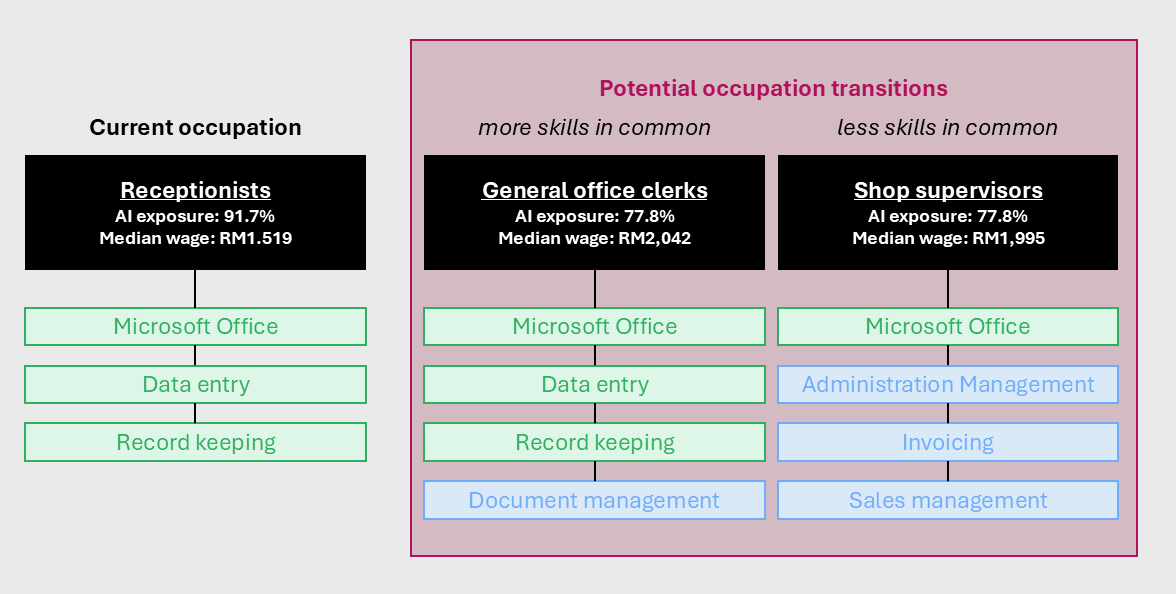
The occupation network explorer uses information on tasks, required skills, AI exposure and median wage to determine feasible occupation transitions. Task lists and skill requirements for each occupation are obtained from the eMASCO platform and cover 456 occupations at the four-digit MASCO level. Task-level AI automation scores and occupation-level AI exposure index are obtained from a previous study conducted jointly by the Institute of Strategic & International Studies (ISIS) Malaysia and the World Bank.9 Median wage estimates are obtained from the 2021 Salaries and Wages Survey published by the Department of Statistics Malaysia (DOSM). A feasible transition is operationally defined as a connection between two occupations where there is at least one shared skill and where the target occupation has a lower AI exposure index and a higher median wage than those of the origin occupation. Thus, every connection in the occupation network explorer represents a transition to an occupation that is accessible through skill training, less exposed to AI technologies and expected to be better remunerated.
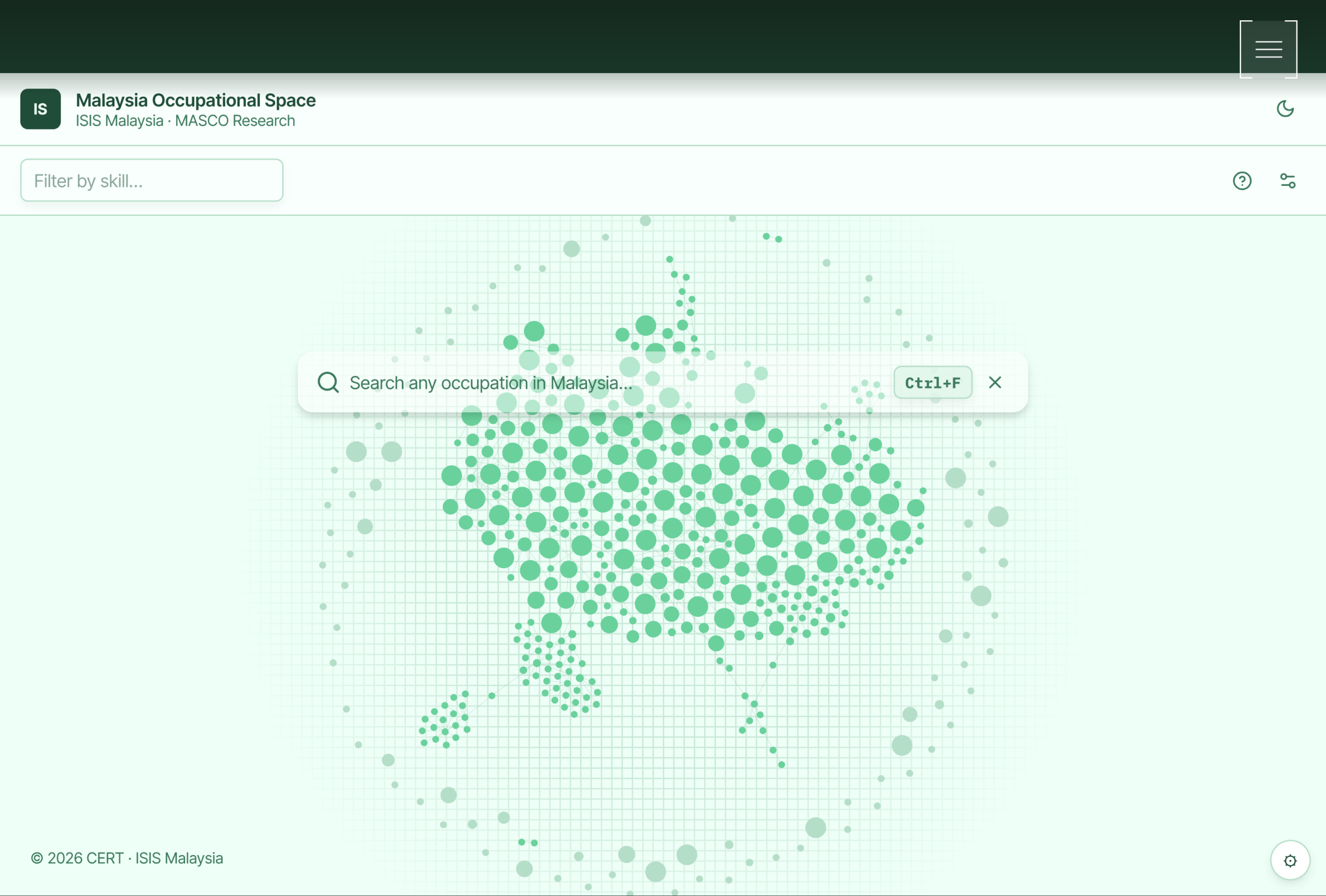
Upon opening the webpage, users encounter an interactive overview of the full occupation network (see Fig. 2). Each node on the network represents a MASCO four-digit occupation. The size of each node is proportional to its AI exposure index, where larger nodes indicate a greater proportion of tasks deemed automatable by current generative AI capabilities.10 The overview of the full network allows users to observe the broad structural features of the occupation landscape. Occupations that are well-connected suggest a broader set of feasible transition pathways, while occupations in the periphery suggest transitions that may require greater effort in skill acquisition. Hovering the computer mouse over any node reveals its immediate neighbours, or the set of occupations that workers can feasibly transition into. A search function is also available to allow users to locate their specific occupation by name without needing to navigate through the entire network.
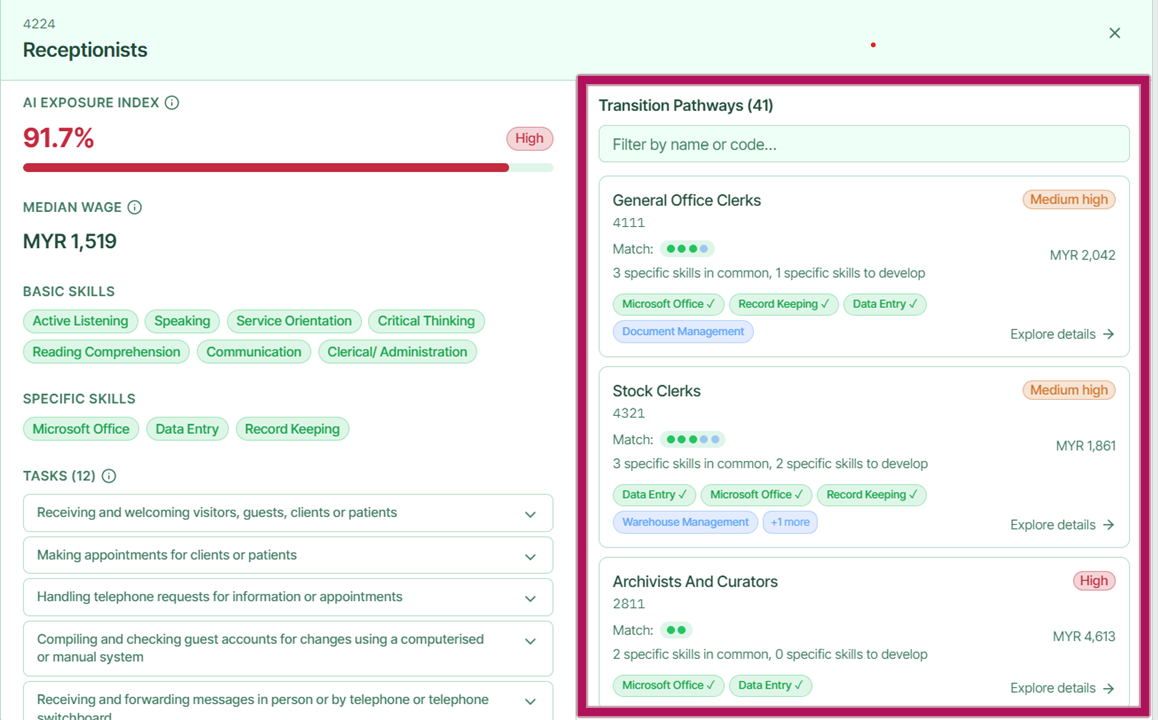
Double-clicking on any occupation opens an occupation detail pane with two columns that provide information about the occupation and potential transitions, respectively (see Fig. 3). The left column presents the profile of the occupation, including its MASCO code and occupation name, its AI exposure index and median monthly wage, and the full list of required skills according to MASCO. This pane also presents a list of typical tasks for the occupation, allowing users to understand the AI exposure driven by task-level disruptions. For instance, receptionists (MASCO 4224) have a high AI exposure because 11 out of their 12 listed tasks involve keeping records or giving information, which AI technologies can readily perform, while the remaining task of “receiving and welcoming visitors, guests, clients or patients” involves human interactions and is unlikely to be automated.
The right column presents a list of feasible occupations to transition into (see Fig. 3). Occupations with more skills in common, lower AI exposure and higher median wages appear first. For each occupation, the table displays the occupation name, the additional skills a worker would need to acquire, the AI exposure index and the median monthlywage. This ranking method translates the abstract concept of occupational skill proximity into a concrete list of alternative occupations ordered by how achievable the transition is. Each row is a potential transition to an occupation that is reachable from a worker’s current set of skills, as well as less exposed to AI and expected to be better remunerated.
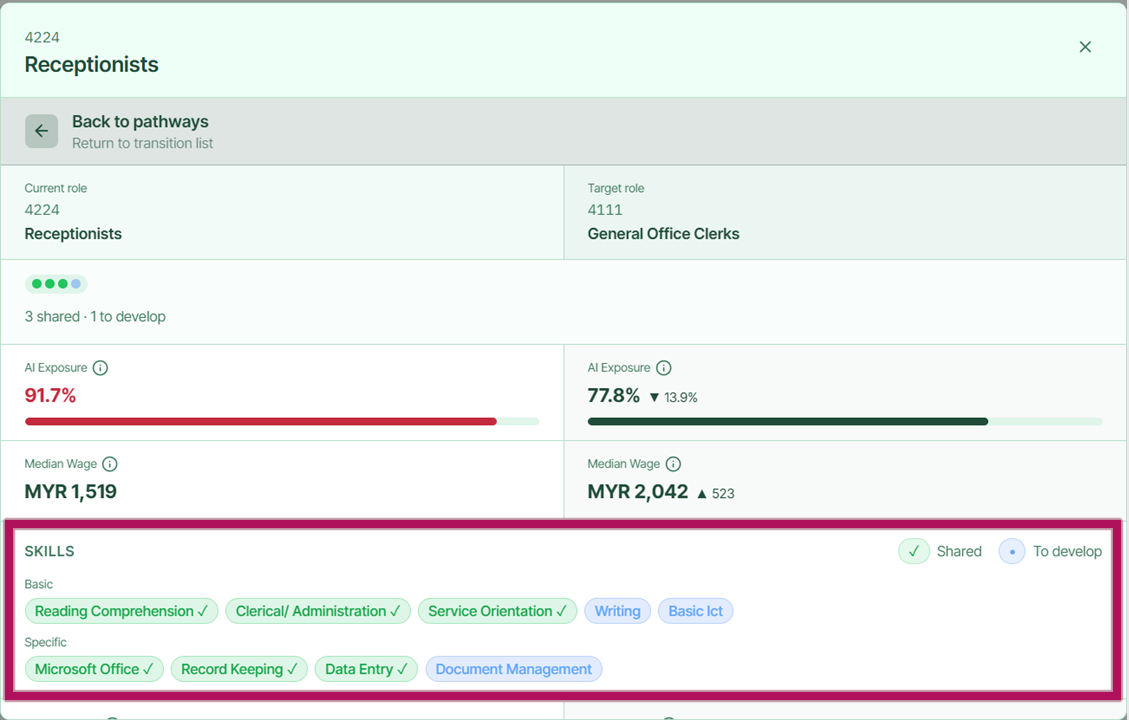
Clicking into any transition occupation opens a side-by-side comparison view designed to point workers towards the skills needed to help them achieve occupation transition (see Fig. 4). The skills panel identifies the skills that workers are expected to already apply in their current or most recent occupation, as well as the skills needed for the occupation transition. This skill-gap analysis is designed to nudge workers to undergo training and acquire skills that will facilitate transition. Retrenched workers seeking skill training support or a career counsellor can identify the specific skills to be developed and then search for training programmes addressing any skill gaps. Although the final step of linking skills to relevant schemes, such as e-LATiH training programmes, and linking occupations to vacancy databases, such as the live data in MYFutureJobs, is not yet built into the current iteration of the occupation network explorer, eventual integration would enhance its utility.
[ 4. Policy use cases ]
The most immediate and pressing use case for the occupation network explorer is supporting retrenched workers navigating sudden job loss. In such a moment, the urgent practical question is how to sustain one’s livelihood, which most often entails transitioning into a new occupation. The occupation network explorer is designed to help workers in this situation identify viable occupations to transition into. By searching for their most recent occupation, retrenched workers can immediately view a network of accessible alternative occupations. These occupations are listed alongside information on transferable skills, skill gap, median wage and AI exposure (see Fig. 2). They can then examine the specific skills required for each transition and identify feasible occupation transitions based on their existing skill set. The occupation network explorer provides retrenched workers with a structured, data-driven view of their transferable skills and potential career options, which may be especially valuable during the uncertainty and disruption of retrenchment.
Another important user group is recent graduates and labour market entrants. Emerging evidence suggests that entry-level roles are more exposed to automation by AI technologies.11 As these roles typically serve as stepping stones to higher-skilled occupations, reduced demand may leave younger workers entering a labour market where available jobs are concentrated in lower-skilled positions with more limited progression pathways. The occupation network explorer enables this group of users to explore occupations and understand the skills required to access better-paying roles over time. A key value is in building awareness of how skill accumulation shapes longer-term career outcomes. These features are also relevant for institutional users, including higher-education career services and placement officers, who can use the occupation network explorer to ground career guidance in labour market data.
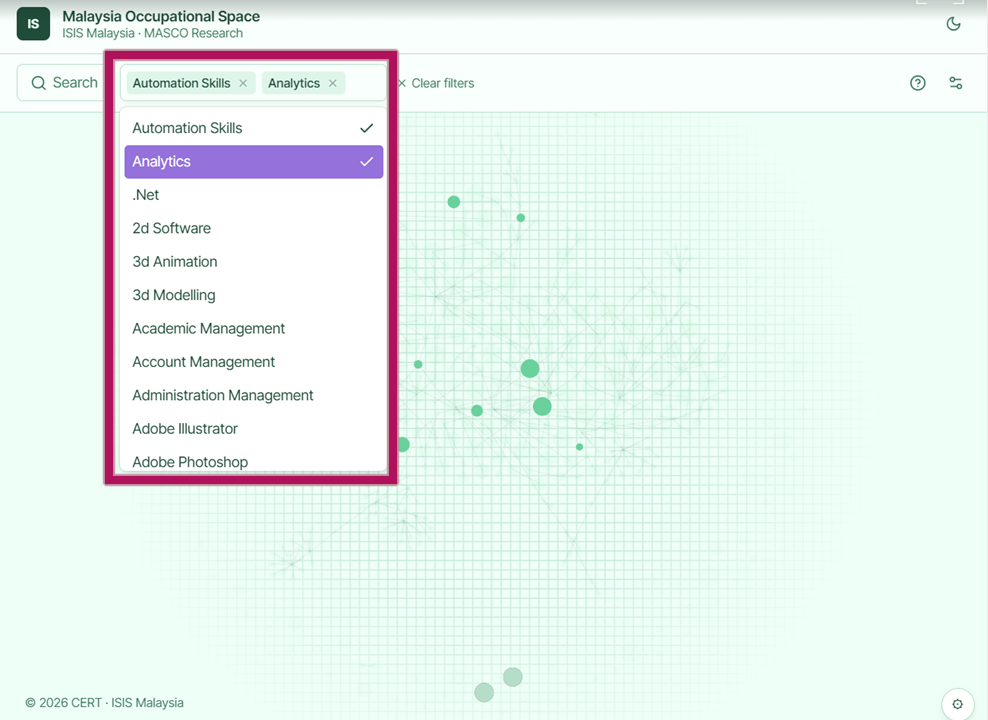
A third user group is workers who wish to invest in lifelong learning but have limited time and resources. The skills filter function at the top left of the occupation network explorer allows users to identify occupations that are accessible upon the acquisition of specific skills (see Fig. 5). A user considering a training investment can use this feature to identify which single skill would expand their set of feasible occupation transitions most broadly. This enables more targeted and effective investment in skill acquisition that increases optionality for users.
Employers are also a potential user group, particularly human resource managers planning workforce adjustments in response to automation. When adopting new technologies in their production systems, some firms adjust internal job structures and redeploy workers across roles. In this context, the occupation network explorer can support employers in identifying skill overlaps across job roles and surface where training investments may enable successful role transitions for staff, potentially leveraging HRD Corp levy funds. The use of the tool as an additional workforce planning instrument for career guidance resources can broaden its potential impact.
[ 5. Future development and policy recommendations ]
While the occupation network explorer in its current iteration is a viable empirical tool for mapping the connections between occupations and identifying skills gaps, its policy impact is contingent on deliberate integration into Malaysia’s current policies for workforce development and worker support. The following policy recommendations address governance, data integration, institutional coordination and the longer-term development of a national skills taxonomy.
[ 5.1 Integration with training catalogue and vacancy data ]
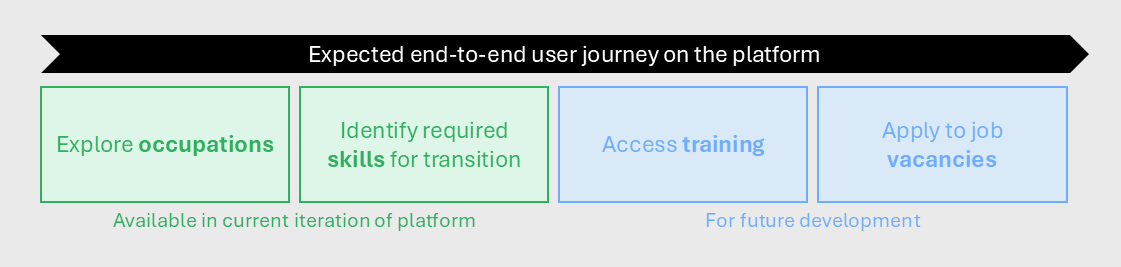
An immediate enhancement to the occupation network explorer is allowing users to access skill-training programmes directly from the occupation detail pane (see Fig. 3). In its current form, this panel shows the skills to develop to facilitate an occupation transition but does not provide a direct call-to-action for users to participate in training (see Fig. 6). Linking each identified skill to relevant courses, such as those from the e-LATiH training catalogue administered by HRD Corp or the EIS training programmes administered by PERKESO, would nudge users towards training via a single interface. Furthermore, adding live vacancy data, such as those from MYFutureJobs, for each target occupation would allow users to validate that demand exists for roles that they might be considering and nudge them towards the job search. Together, these integrations move users from diagnosis to action and represent an effort to consolidate Malaysia’s existing labour market and training platforms.
Realising this integration would require data-sharing agreements and application programming interface linkages between the occupation network explorer and relevant organisations, such as HRD Corp and PERKESO. The first step would be to establish an institutional home to anchor the partnerships. The MyMahir platform, launched by TalentCorp in 2024 as a digital platform focused on skills development, is a viable option. From there, inter-agency data sharing can be coordinated through clear ownership and a shared development roadmap led by TalentCorp, as the think tank for KESUMA, or by the ministry itself. A practical starting point would be to pilot an integration of a subset of occupations and skills with the highest data quality before expanding as underlying data systems mature.
[ 5.2 Implementation through Employment Insurance System ]
The most viable deployment channel for the occupation network explorer is the EIS intake process administered by PERKESO. Under the current EIS framework, retrenched workers who have contributed to the scheme are entitled to income support and re-employment services, including career counselling and skill training.12 Integrating the occupation network explorer to this intake process would allow a PERKESO employment services officer to utilise the platform at the point of initial consultation to generate a real-time view of feasible transition pathways for a retrenched worker, alongside the skills to develop. The counsellor could then use this output to lead the conversation towards specific, achievable occupation transitions and to make data-driven recommendations for training and vacancies.
Deployment would require PERKESO to train its employment services officers on the platform and to incorporate the occupation network explorer into its case management workflow. It would also be valuable to deploy the platform as a self-service for EIS claimants through the existing MYFutureJobs portal so that workers can explore transition options independently. Evidence from employment service programmes internationally suggests that jobseekers with clearer information on their skills can achieve improved re-employment outcomes.13 As a starting point, a pilot could integrate the occupation network explorer into the counselling process and assess the platform’s impact by comparing re-employment outcomes between pilot participants and a comparison group of jobseekers who did not enrol in the pilot.
[ 5.3 Establish governance and regular data updates under KESUMA ]
The validity of the information in the occupation network explorer depends on the accuracy of the underlying data. The tool currently draws on two essential data layers: information on occupations, tasks and skills from eMASCO and wage estimates from the Labour Force Survey administered by the DOSM. As the task structure and skill requirements of occupations evolve with technological change and economic transformation, the data inputs should be updated regularly in line with the update cycles of these datasets.
Governance of the platform should be located within KESUMA, which already administers and regularly updates MASCO and eMASCO, oversees HRD Corp and PERKESO, and coordinates labour market data collection across agencies. The next step would be to establish a data-sharing agreement with the DOSM to obtain timely wage data aligned with the annual release of the Salaries and Wages Survey. For occupation and skills data, a complementary mechanism could identify emerging roles and skills through TalentCorp and incorporate them into MASCO as they mature.
[ 5.4 Develop a national occupational skills taxonomy ]
While the occupation network explorer demonstrates the value of linking occupation and skills data, the current eMASCO skills dataset has important limitations that constrain its utility. The coverage of skills across occupations is not yet comprehensive, with some occupations missing some skills data. Furthermore, the logic for linking skills to occupations is currently opaque and limits the interpretation of the resulting skill pathways. These gaps point to the need to strengthen the underlying skills framework by referencing existing international benchmarks, or even private sector systems, such as Lightcast.14
The existing National Occupational Skills Standard (NOSS) presents a possible foundation to develop a national skills taxonomy. NOSS currently focuses on skilled occupations and does not cover the full range of occupations in MASCO. It could be expanded into a comprehensive occupational skills taxonomy to provide a common skills language across a workforce development and worker support system, such as Singapore’s Skills Frameworks.15 Drawing on international practice, such a taxonomy should define at least a core set of skills for each occupation in a consistent and transparent way. Development could be led through a coordinated effort by KESUMA or TalentCorp in collaboration with the Malaysian Qualifications Agency and relevant industry stakeholders by sector. Once established, agencies, such as HRD Corp, could align training programmes with the identified skills framework. Collectively, this would enable workers to better understand transferable skills and provide a more accurate and structured view of possible occupation transitions based on shared skill requirements.
[ 5.5 Include labour disruption risks as a core consideration in Malaysia’s AI agenda ]
Malaysia has an ambitious national AI agenda driven by attracting AI investments, expanding AI adoption and building AI talent. The establishment of the National AI Office (NAIO) reflects a strong government commitment to positioning Malaysia as a competitive AI economy. However, a national AI strategy focused primarily on productivity gains without equal attention to labour market adjustment risks overlooking impacts on vulnerable workers, potentially entrenchingexisting inequalities and fuelling social instability. While agencies, such as TalentCorp, have begun examining the potential labour market effects of AI,16 these effects receive less systematic attention than the AI adoption agenda. Managing workforce transitions, rather than responding to AI adoption, should form a core pillar of Malaysia’s AI strategy.
In this context, collaboration between NAIO, KESUMA and related agencies could strengthen workforce planning for an AI-enabled economy through various mechanisms, such as the MyMahir–National AI Council for Industry initiative. Crucially, efforts should place equal emphasis on building AI talent and monitoring AI-related workers, including through early warning signals drawn from PERKESO loss-of-employment data. Moreover, public AI adoption initiatives should be linked to workforce development and worker support measures. Firms and sectors benefiting from AI-related government incentives or public investment could be encouraged — and, where feasible, required — to develop a workforce transition plan that assesses potential impacts on workers and outlines corresponding support measures, such as redeployment, retraining or placement assistance. The occupation network explorer could support these efforts as an analytical tool for identifying occupation transition pathways and informing the design of transition plans.
[ 6. Conclusion ]
Policy choices today shape how gains from technological progress are distributed. Active governance of technological adoption can deliver more equitable outcomes than reliance on market forces alone, particularly when AI adoption remains at an early stage. For Malaysia, this creates a window to act deliberately. The occupation network explorer is a tool that can support this agenda by enabling more active monitoring and management of the labour market by anticipating occupation transitions and guiding training policies in response to labour market shocks.
[ Contributor ]
Hanson Chong is a senior researcher in the Economics, Trade and Regional Integration programme at ISIS Malaysia. His work focuses on the intersection between human capital and social capital, including topics in labour markets and jobs, skills development and education, and the formation of friendship networks. He graduated from the London School of Economics and Political Science with an MSc in Social Research Methods supported by the Khazanah Postgraduate Global Scholarship and completed his BSc (Hons) in Economics at the University of Nottingham Malaysia.
[ Illustrator ]
Lisa is a Malaysian illustrator with a background in architecture. She creates atmospheric, environment-driven illustrations with a playful, intuitive and dreamy touch. Lisa enjoys building worlds that invite viewers to slow down, wander, and discover their own meanings.
[ Notes ]
This policy paper serves as a companion to the occupation network explorer (accessible at https://cert.isis.org.my/skill-pathways-tool).
[ REFERENCES ]
1Cheng, C., Chong, H., Dornan, M. & Jasmin, A. F. (2025). Novel AI Technologies and the Future of Work in Malaysia [Policy brief]. ISIS Malaysia. https://www.isis.org.my/wp-content/uploads/2025/08/Novel-AI-technologies-PB.pdf
2Bank Negara Malaysia. (2023). Economic and Monetary Review 2023. https://www.bnm.gov.my/documents/20124/12141961/emr2023_en_book.pdf
3Nagaya, D., Bustami, R., & Afdzal, A. S. (2024). Impact Study of AI, Digital, and Green Economy on the Malaysian Workforce — Volume 1. TalentCorp. https://www.mymahir.my/publication/1/impact-study-of-ai-digital-and-green-economy-on-the-malaysian-workforce
4Braxton, J. C. & Taska, B. (2023). Technological change and the consequences of job loss. American Economic Review, 113(2): 279–316. https://doi.org/10.1257/aer.20210182
5World Bank. (2026). What Works for Work: A Guidebook to Proven and Promising Employment Solutions. https://www.worldbank.org/en/topic/labormarkets/publication/what-works-for-work-proven-promising-employment-solutions
8HRD Corp. (2024, July 4). National Audit Department and Public Accounts Committee Report [Press release]. https://hrdcorp.gov.my/wp-content/uploads/2024/07/04072024_Press-Release_National-Audit-Department-and-Public-Accounts-Committee-Report.pdf
11Brynjolfsson, E., Chandar, B., & Chen, R. (2025). Canaries in the Coal Mine? Six Facts about the Recent Employment Effects of Artificial Intelligence [Working paper]. Stanford Digital Economy Lab. https://digitaleconomy.stanford.edu/app/uploads/2025/11/CanariesintheCoalMine_Nov25.pdf
12Pertubuhan Keselamatan Sosial. (n.d.). Employment Insurance System for Insured Persons (IP) Who Have Lost Their Jobs (LINDUNG KERJAYA). https://www.perkeso.gov.my/en/our-services/protection/employment-insurance.html
13Carranza, E., Garlick, R., Orkin, K. & Rankin, N. (2022). Job search and hiring with limited information about workseekers’ skills. American Economic Review, 112(11): 3547–3583. https://doi.org/10.1257/aer.20200961
14Lightcast. (n.d.). Lightcast Skills Taxonomy: The Global Standard in Skills. https://lightcast.io/open-skills
15Jobs-SkillsPortal. (n.d.). Frameworks. Government of Singapore. https://jobsandskills.skillsfuture.gov.sg/frameworks/skills-frameworks